
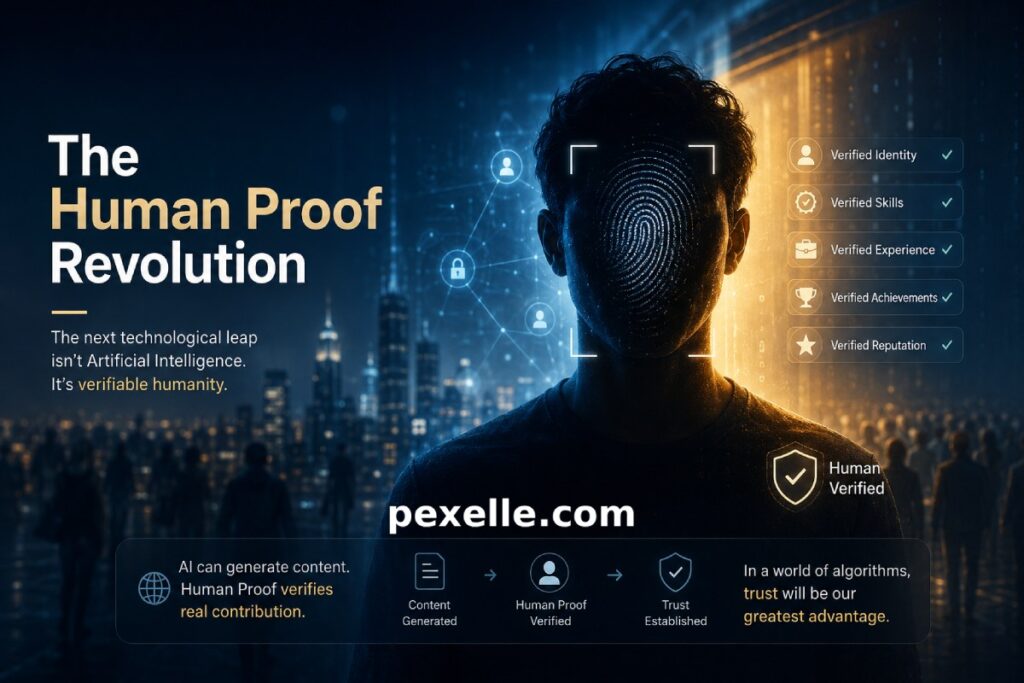
Why the Next Technological Leap Isn’t Artificial Intelligence. It’s Verifiable Humanity.
For the past three decades, the internet has been optimized for one thing: moving information.
The next three decades will be optimized for something entirely different:
Proving that the information came from a real, capable, accountable human.
This is the beginning of the Human Proof Revolution.
And it may become one of the most important technological shifts of the century.
We Solved Communication. We Never Solved Trust.
The internet solved distance.
Email replaced letters.
Video calls replaced travel.
Cloud computing replaced physical offices.
AI is now replacing many forms of knowledge work.
Yet despite all this progress, one problem remains surprisingly unsolved:
How do we know who is actually behind the screen?
Today we can verify:
- bank transactions
- software packages
- SSL certificates
- domain ownership
- cryptocurrencies
- digital signatures
But we still struggle to answer simple human questions:
- Did this person actually write this?
- Does this individual really possess these skills?
- Is this experience genuine?
- Is this portfolio authentic?
- Is this recommendation real?
- Can this identity be trusted?
Ironically, our technology has become incredibly sophisticated while our methods for trusting people remain surprisingly primitive.
AI Changed the Equation
Artificial intelligence didn’t create the trust problem.
It exposed it.
When content generation was expensive, originality was assumed.
Now it costs almost nothing.
- A report.
- A presentation.
- A resume.
- A software application.
- A research paper.
- A marketing campaign.
Even an entire startup can now be created with AI assistance in days.
This is remarkable progress.
But it introduces an unavoidable consequence.
If anyone can generate impressive output instantly…
How do we distinguish capability from generation?
Credentials Are Becoming Less Valuable
For decades, society relied on credentials as proxies for competence.
Degrees.
Employer names.
Years of experience.
These worked because creating convincing evidence required significant effort.
Now AI can produce resumes that look exceptional.
Portfolios that appear professional.
Writing that sounds expert.
Code that compiles.
Designs that impress.
Presentations that persuade.
The appearance of competence is becoming increasingly affordable.
Actual competence is not.
That distinction will define the coming decade.
Human Proof Is More Than Identity
Many people confuse identity verification with human verification.
They’re different problems.
Identity answers:
“Who are you?”
Human Proof answers much larger questions:
- What can you actually do?
- What have you genuinely accomplished?
- Which skills have been independently demonstrated?
- How consistently have you delivered results?
- Can your reputation be verified?
- Can your expertise evolve over time?
Human Proof transforms static identity into living credibility.
Reputation Will Become Programmable
Today reputation lives in isolated platforms.
LinkedIn knows your career.
GitHub knows your code.
Behance knows your designs.
Google Scholar knows your research.
Upwork knows your freelance work.
Universities know your education.
Employers know your history.
None of these systems truly communicate.
Imagine instead a universal layer where verified achievements continuously accumulate.
- Every completed project.
- Every validated skill.
- Every peer endorsement.
- Every measurable contribution.
- Every professional milestone.
Instead of rebuilding trust every time you change jobs, industries, or countries, your verified reputation travels with you.
Trust Will Become Infrastructure
Infrastructure isn’t exciting.
Nobody talks about electrical grids every day.
Or internet routing.
Or payment networks.
Yet modern civilization depends on them.
Trust is following the same path.
Today trust is fragmented.
Tomorrow it becomes infrastructure.
Invisible.
Always available.
Always verifiable.
Built into every digital interaction.
When trust becomes infrastructure, every marketplace becomes more efficient.
Hiring improves.
Freelancing improves.
Education improves.
Healthcare improves.
Government services improve.
Financial services improve.
Even social media changes.
Because verified humans behave differently than anonymous identities.
The Rise of Human Proof Economies
Every major technological revolution creates new markets.
Electricity created appliances.
The internet created e-commerce.
Smartphones created the app economy.
AI is creating the automation economy.
Human Proof will create something even larger:
The credibility economy.
In this economy, verified capability becomes an asset.
Not just a resume.
Not just a profile.
A living digital record of demonstrated ability.
Organizations will increasingly compete to identify verified talent rather than simply evaluate claims.
Individuals will invest in building provable reputations instead of polished personal brands.
AI Doesn’t Replace Human Proof
Some believe AI makes human verification unnecessary.
The opposite is true.
The more AI creates…
the more valuable verified human contribution becomes.
AI raises productivity.
Human Proof raises confidence.
AI generates possibilities.
Human Proof establishes accountability.
AI creates content.
Human Proof creates credibility.
These are complementary technologies.
Not competing ones.
Every Industry Will Change
Consider recruitment.
Today companies screen resumes.
Tomorrow they may evaluate verified skill histories.
Consider education.
Degrees may become one signal among many.
Verified demonstrations of competence may matter even more.
Consider freelancing.
Instead of five-star ratings, clients may evaluate immutable records of successful work.
Consider enterprise security.
Instead of simply authenticating employees, organizations may authenticate expertise.
Even governments may eventually rely on Human Proof systems to improve digital public services, reduce fraud, and streamline credential recognition across borders.
The Companies That Build Trust Will Define the Next Internet
History rarely rewards those who simply build larger platforms.
It rewards those who solve foundational problems.
Google organized information.
Stripe simplified payments.
Cloudflare secured the web.
Git transformed software collaboration.
The next generation of technology leaders may focus on something even more fundamental:
Making human credibility verifiable at internet scale.
Because every digital interaction ultimately depends on trust.
The Human Layer of the Internet
- The internet has layers.
- Infrastructure.
- Networking.
- Applications.
- Payments.
- Cloud services.
- Artificial intelligence.
- Yet one critical layer is still missing.
- The human layer.
A universal way to verify not only who people are, but what they can genuinely contribute.
That layer won’t replace AI.
- It will make AI trustworthy.
- It won’t replace digital identity.
- It will give identity meaning.
- It won’t replace reputation.
- It will make reputation portable, measurable, and verifiable.
Conclusion
Every technological revolution eventually shifts from increasing efficiency to increasing confidence.
Artificial intelligence has dramatically expanded what machines can create.
The next revolution will determine what humans can prove.
In a world where almost anything can be generated, authenticity becomes scarce.
Scarcity creates value.
And in the coming digital economy, the most valuable asset may not be intelligence alone.
It will be verifiable humanity.
The Human Proof Revolution has already begun.
The only remaining question is:
Will we continue trusting claims, or will we start trusting proof?
Source : Medium.com