When AI Can Create Resumes, Portfolios, Degrees, and Recommendations, How Will We Measure Human Trust?
For centuries, human societies have relied on proxies of credibility.
A university degree suggested competence. A professional resume indicated experience. A portfolio demonstrated capability. Recommendation letters reflected trust earned from others. Together, these signals formed the foundation of hiring, business relationships, education, and social mobility.
But what happens when artificial intelligence can generate all of them?
We are approaching a moment that may fundamentally reshape how trust is established in the digital age. A future where resumes can be written perfectly, portfolios can be manufactured instantly, recommendation letters can be generated convincingly, and certifications can be simulated at scale.
The challenge is no longer whether AI can create these artifacts.
The challenge is whether these artifacts will continue to mean anything at all.
The Collapse of Traditional Signals
Historically, credentials acted as shortcuts.
Employers could not directly observe years of experience, so they evaluated resumes.
Clients could not fully assess expertise, so they reviewed portfolios.
Universities could not predict future success, so they issued degrees and certificates.
These systems were imperfect but functional because producing convincing evidence required significant effort, time, and real-world achievement.
AI changes this equation.
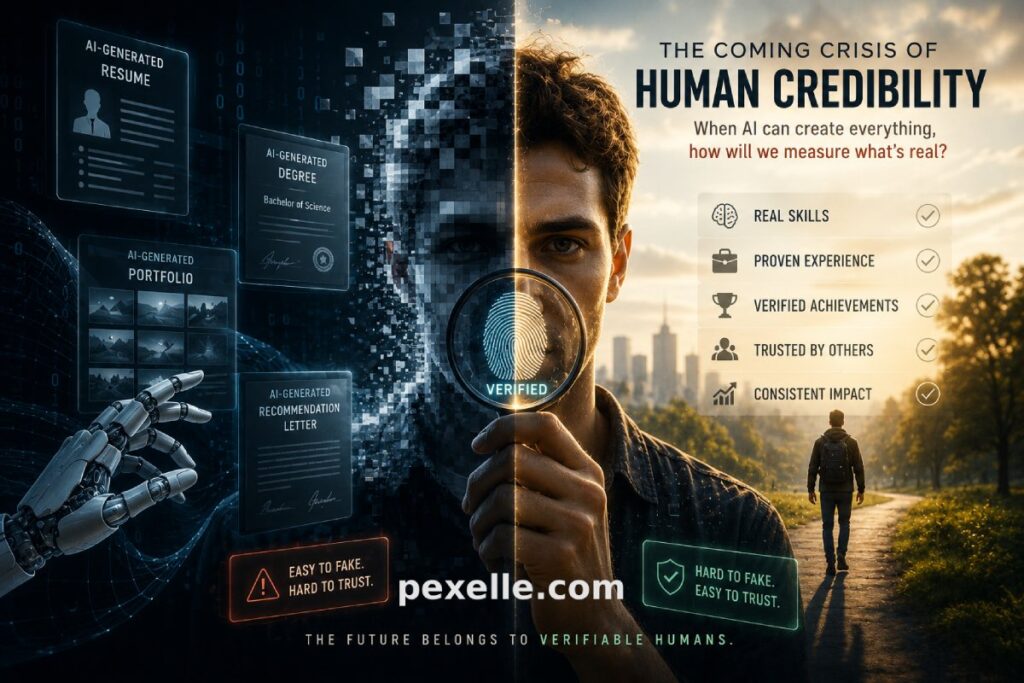
Today, large language models can generate professional resumes tailored to specific job descriptions within seconds. Design systems can create realistic portfolios. AI video tools can produce demonstrations of projects that never existed. Recommendation letters can be written in any style, tone, or level of professionalism.
As the cost of producing evidence approaches zero, the value of that evidence begins to decline.
When everyone can present an impressive narrative, the narrative itself loses power.
The New Credibility Gap
The emerging problem is not misinformation.
It is verification.
Most organizations do not struggle to receive information. They struggle to determine whether that information is authentic.
A hiring manager may receive hundreds of applications, each appearing exceptional.
An investor may review polished presentations created largely by AI.
A client may evaluate agencies whose case studies are partially synthetic.
A university may assess applications enhanced by increasingly sophisticated AI systems.
The gap between appearance and reality grows wider every year.
In such an environment, credibility becomes scarce.
And scarcity creates value.
Why Human Ability Is Becoming Harder to Measure
One of the most significant shifts created by AI is the separation between output and capability.
Historically, producing high-quality output generally required possessing the underlying skill.
Writing a technical article required technical understanding.
Designing a product required design expertise.
Creating software required programming knowledge.
AI weakens these relationships.
An individual may produce professional work without fully understanding how it was created.
This does not necessarily imply deception. AI can genuinely increase productivity and capability.
However, it creates uncertainty.
Observers can no longer easily distinguish between:
The distinction becomes increasingly important when evaluating trust, responsibility, and expertise.
The Rise of Proof-Based Credibility
The future may belong to proof rather than presentation.
Instead of asking:
“What does your resume say?”
Organizations may ask:
“Can you prove your capability right now?”
Instead of evaluating historical credentials, systems may focus on live demonstrations, verified contributions, and observable performance.
Examples include:
- Real-time skill assessments
- Verified project histories
- Public contribution records
- On-chain achievement verification
- Continuous reputation systems
- Practical simulations
- Collaborative problem-solving exercises
In this model, credibility becomes dynamic rather than static.
It is earned continuously rather than granted once.
Reputation as a Living Asset
In the coming decade, reputation may become one of the most valuable forms of capital.
Not reputation based on marketing.
Not reputation based on self-description.
But reputation built through verifiable actions.
Imagine a future where every meaningful contribution leaves a cryptographically verifiable record.
Projects completed.
Problems solved.
Communities helped.
Knowledge shared.
Professional relationships maintained.
Instead of relying on a PDF resume, individuals may carry an evolving reputation graph that reflects real-world impact over time.
The question shifts from:
“What do you claim to be?”
To:
“What have you consistently demonstrated?”
The Role of Blockchain and Verifiable Credentials
Blockchain technology may play a crucial role in addressing the credibility crisis.
Not because every achievement needs to exist on-chain.
But because decentralized verification can provide tamper-resistant evidence.
Verifiable credentials could allow institutions, employers, and communities to issue trusted attestations without requiring centralized databases.
- Educational achievements.
- Professional certifications.
- Work contributions.
- Volunteer activities.
- Research outputs.
All could become independently verifiable.
The objective is not to eliminate trust.
It is to make trust measurable.
The Danger of a Synthetic Society
If society fails to adapt, we may enter an era where distinguishing genuine expertise becomes increasingly difficult.
The consequences extend beyond hiring.
Healthcare professionals.
- Engineers.
- Financial advisors.
- Researchers.
- Public officials.
Trust in these roles affects lives, economies, and institutions.
When synthetic credibility becomes easier to create than authentic credibility, confidence in institutions begins to erode.
This is not merely a technological problem.
It is a societal challenge.
The Future Belongs to Verifiable Humans
Ironically, the more advanced AI becomes, the more valuable authentic human proof may become.
In a world flooded with generated content, genuine experience becomes rare.
In a world filled with synthetic portfolios, verified achievements become valuable.
In a world where anyone can create impressive claims, demonstrated competence becomes the ultimate differentiator.
The coming crisis of human credibility is not about AI replacing people.
It is about society learning how to identify, verify, and trust people in an age where appearances can be manufactured effortlessly.
The organizations that solve this challenge will build stronger teams.
The platforms that solve this challenge will create more trustworthy ecosystems.
And the individuals who can consistently prove their abilities will thrive in a future where credibility becomes humanity’s most valuable asset.
Conclusion
Artificial intelligence is transforming the economics of trust.
Resumes, portfolios, certificates, and recommendation letters were designed for a world where creating evidence was difficult.
That world is disappearing.
The next era will not reward those who can make the strongest claims.
It will reward those who can provide the strongest proof.
As AI continues to blur the line between appearance and reality, the most important question of the digital age may no longer be:
“What can you say about yourself?”
But rather:
“What can you verify?”
Source : Medium.com