
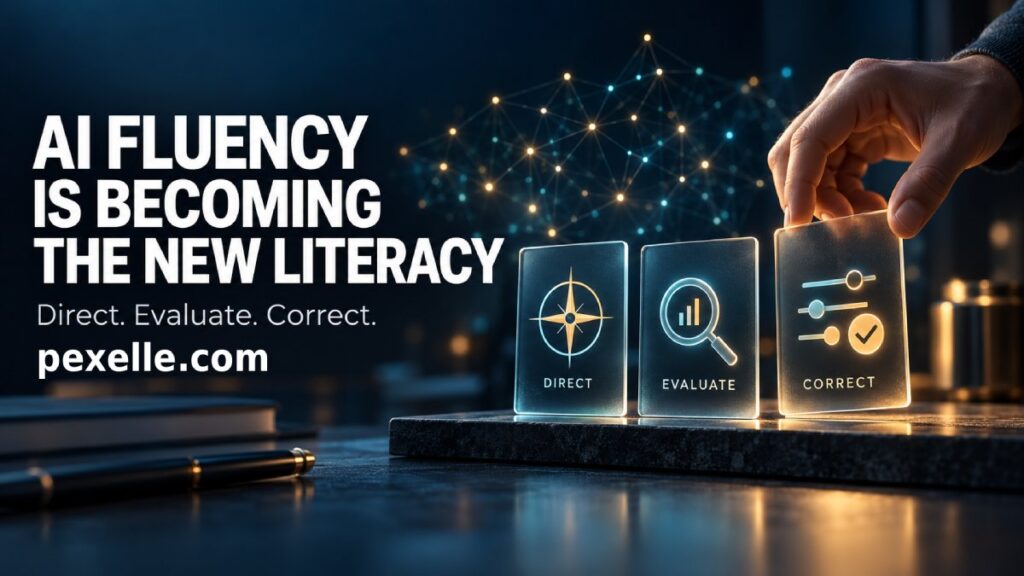
Why the ability to direct, evaluate, and correct AI could define the next generation of professional skill
Two professionals receive the same assignment. Both have access to the same AI tool.
The first asks for an answer, makes a few cosmetic changes, and submits it.
The second defines the problem, supplies relevant context, examines the assumptions, checks the evidence, and corrects what the system gets wrong.
Their final documents may look equally polished. Their work is not equally trustworthy.
This distinction sits at the heart of AI fluency.
Knowing how to open ChatGPT and write a prompt is a starting point. It tells us little about whether someone can use AI to produce work that deserves confidence.
As access to these tools becomes more ordinary, a more useful question emerges:
Can you direct, evaluate, and correct AI?
That question could reshape how we teach professional skills, assess capability, and design the next generation of Skill Cards.
What “Literacy” Really Means Here
The comparison with literacy is useful, but it needs care.
Traditional literacy includes understanding what we read, interpreting meaning, assessing credibility, and communicating clearly. Recognizing words is only one part of it.
AI fluency calls for a similar depth of engagement.
A person can operate an AI interface while misunderstanding its output. They can generate a sophisticated report without recognizing unsupported claims. They can automate a workflow without knowing when it should stop.
For this article, AI fluency means the ability to work deliberately with AI: setting a useful direction, judging the result, and intervening when necessary.
It combines communication, domain knowledge, critical thinking, and responsibility.
The strongest evidence of fluency may be a decision to reject an answer, narrow an assignment, or complete part of the work without AI.
1. Direct: Turn an Intention Into a Clear Assignment
Effective direction starts before the prompt.
What problem needs solving? Who will use the result? What information is available? What constraints matter? What would count as success?
Consider a request to “write a customer proposal.”
An AI system could produce something persuasive while inventing delivery commitments, assuming the wrong audience, or recommending services the business cannot provide.
A fluent professional establishes the boundaries first. They specify the customer’s needs, the approved service offering, the available evidence, the budget constraints, and the claims that require confirmation.
They also decide which parts of the task are suitable for delegation.
Drafting a structure may be appropriate. Making a binding commercial commitment may require a responsible person to review and approve it.
Good direction reduces the space for consequential misunderstanding.
This ability should survive a change of interface. Someone who understands objectives, constraints, and acceptance criteria can apply that judgment across different tools.
That makes direction a more durable capability than familiarity with a particular prompt formula.
2. Evaluate: Decide Whether the Result Deserves Trust
A polished answer can make weak reasoning difficult to notice.
Readable prose, a clean table, or plausible code may create an impression of completeness before anyone has checked whether the underlying work is correct.
Evaluation requires looking beneath that presentation.
Does the output answer the actual question? Are the sources relevant? Do the calculations reconcile? Are the assumptions justified? What information is missing? How would an error affect the people using the result?
The appropriate checks depend on the task.
A social caption may need a factual and editorial review. A financial forecast requires scrutiny of its inputs and calculations. A software change needs validation against the actual system and intended behavior.
AI fluency therefore cannot be separated entirely from domain knowledge.
A person may be skilled at directing AI-generated marketing copy while lacking the expertise to assess a structural engineering recommendation. Competence in one context should not be treated as universal authority.
A credible assessment asks what someone can evaluate, under which conditions, and to what standard.
Using another AI system to review an answer can support this process, but agreement between systems is not independent proof. Where correctness matters, the review must connect to evidence, tests, or qualified human judgment.
3. Correct: Improve the Work and Verify the Improvement
Recognizing a problem is only part of the job.
The next challenge is correcting it without introducing another failure.
“Try again” offers little guidance. A useful correction identifies what failed and why.
Perhaps the system used an unsupported assumption. Perhaps it misunderstood a requirement. Perhaps the source material was incomplete, or the assignment was too broad to handle reliably in one step.
Each problem calls for a different intervention.
The professional might provide better evidence, revise the instructions, divide the task, edit the result directly, or stop the process and seek specialist review.
Then comes a crucial step: checking the correction.
An answer that sounds better may still be wrong. A revised calculation may fix one figure while breaking another. A code change may solve the immediate issue while altering behavior elsewhere.
Correction is complete only when the revised result has been evaluated again.
This is where AI fluency becomes an observable working practice: direct, inspect, intervene, and verify.
The Competence Hidden Behind a Finished Output
AI-assisted work creates a challenge for assessment.
A finished artifact can reveal quality, but it may conceal how that quality was achieved.
Did the person understand the assignment? Did they detect mistakes? Did they verify important claims? Could they explain the result? Would they recognize a failure if the next output were less reliable?
A strong document alone cannot answer every one of these questions.
Assessment should therefore consider both the result and selected evidence of the decisions behind it.
That does not require recording every interaction or exposing confidential material. A carefully designed exercise can capture the essential evidence: the initial brief, the problems identified, the corrections made, and the checks used before acceptance.
One particularly revealing exercise would give a candidate a polished AI-generated answer containing deliberate flaws.
The task would be to identify those flaws, explain their significance, correct them, and justify the final version.
This tests judgment more directly than asking someone to produce an impressive answer from scratch.
What This Means for the Next Generation of Skill Cards
A generic “AI Proficient” badge provides too little information.
It leaves employers, collaborators, and clients guessing about what was demonstrated.
For Pexelle, this suggests an opportunity to design Skill Cards around specific, observable capabilities.
An AI fluency card could organize evidence around three dimensions:
| Dimension | Capability demonstrated | Possible evidence |
|---|---|---|
| Direct | Defines objectives, context, constraints, and acceptance criteria | A task brief with justified delegation boundaries |
| Evaluate | Detects errors, unsupported claims, and missing requirements | An annotated review supported by appropriate checks |
| Correct | Resolves identified problems and validates the revision | A corrected deliverable with verification evidence |
The card should also describe the domain, task complexity, level of independence, assessment method, and date of assessment.
For example, “AI-Assisted Customer Research” tells us more than “AI Expert.” It can specify whether the person demonstrated source verification, separation of evidence from inference, and correction of unsupported conclusions.
A credible card should distinguish between completing an exercise with guidance and managing a comparable task independently.
It should also remain modest about what its evidence proves. One successful assessment supports a defined capability claim; it does not establish unlimited competence.
Access Should Be Part of the Assessment
There is another issue to address: unequal access.
People may work with different models, paid features, training opportunities, and organizational support. An assessment that rewards the most powerful setup can confuse access with ability.
A fair design should make the assessment conditions visible and, where practical, provide comparable tools.
The emphasis should remain on the quality of the person’s decisions.
Can they work effectively with the resources available? Can they identify limitations? Can they explain when better information or human expertise is needed?
These questions help keep AI fluency grounded in demonstrated judgment.
A Higher Standard for Human Responsibility
AI fluency should not become a competition to delegate the most work.
Delegation is useful when it improves an outcome and remains within appropriate boundaries. The amount delegated is a poor measure of competence by itself.
A fluent professional understands which decisions they can make, which require approval, and which fall outside their expertise.
They can explain what was checked and what remains uncertain.
That transparency matters because other people must decide whether to rely on the result.
The promise of AI fluency is therefore practical: better direction, more credible evaluation, and more disciplined correction.
The Question That Will Matter
“Can you use ChatGPT?” is easy to answer and difficult to interpret.
“Can you direct, evaluate, and correct AI in this kind of work?” is a much stronger question.
It asks for evidence of a professional’s contribution, including the judgment that a polished output can hide.
For Pexelle, the next generation of Skill Cards could make that contribution visible. They could show where someone has demonstrated the ability to turn AI assistance into work that meets a defined standard.
The new literacy will be measured by what people understand, verify, and take responsibility for when AI participates in their work.
Source : Medium.com