How Will Professional Identity Be Defined in the Next Decade?
For generations, professional identity was relatively simple. People introduced themselves through their job titles.
“I am a doctor.”
“I am a software engineer.”
“I am a teacher.”
A profession was often a lifelong commitment. Degrees, certifications, and years of experience formed the foundation of credibility. Companies served as identity anchors, and careers followed predictable paths.
The next decade will fundamentally change this model.
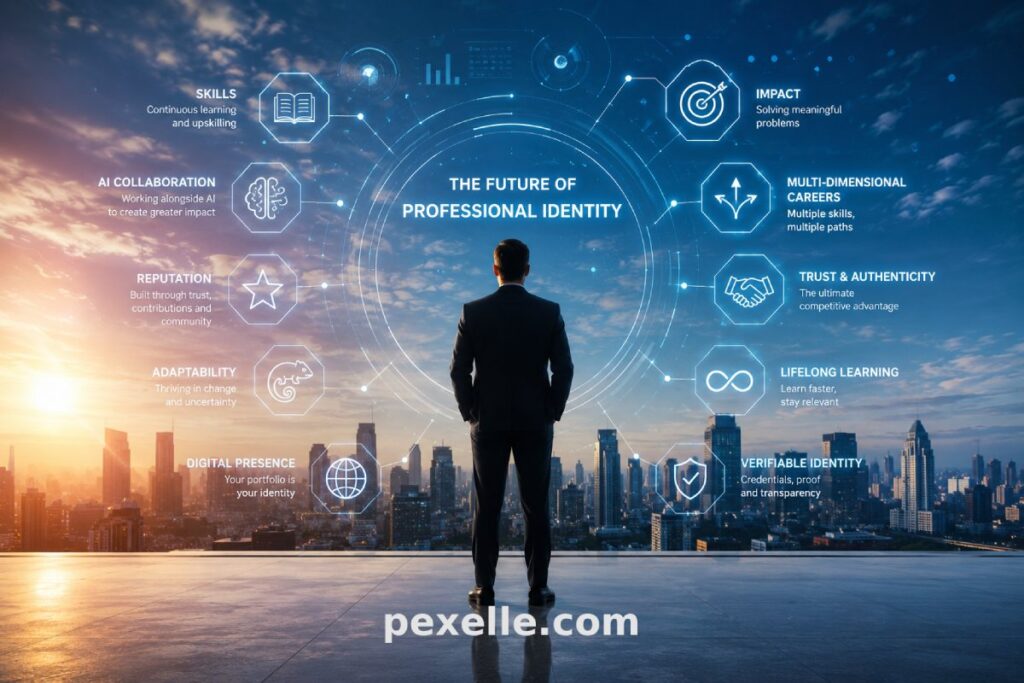
Artificial intelligence, automation, remote work, creator economies, decentralized organizations, and continuous learning are reshaping the relationship between people and work. As a result, professional identity is evolving from a static label into a dynamic digital representation of skills, impact, adaptability, and reputation.
The question is no longer:
“What do you do?”
The question is becoming:
“What value can you create, and how quickly can you adapt?”
The End of Job Titles as Primary Identity
Job titles have long acted as shortcuts.
They helped organizations categorize people and helped individuals communicate expertise. However, titles are increasingly becoming insufficient.
Consider two people with the same title:
“Software Engineer.”
One may spend most of the day maintaining legacy systems.
The other may lead AI architecture, automate workflows, mentor teams, and contribute to open-source projects.
Despite sharing the same title, their capabilities and impact are dramatically different.
As AI automates routine work, organizations will focus less on titles and more on measurable outcomes.
Future professional identity will be built around demonstrated capabilities rather than organizational labels.
People will increasingly be known for:
- Their skills
- Their portfolio
- Their contributions
- Their problem-solving ability
- Their reputation within communities
Instead of saying:
“I work as a Product Manager.”
People may say:
“I specialize in launching AI-powered products that scale from zero to one million users.”
The focus shifts from position to impact.
Skills Will Become More Valuable Than Degrees
Degrees will remain important, especially in regulated professions such as medicine, law, and engineering.
However, many industries are already moving toward skills-first hiring.
Organizations increasingly care about:
- What you can do
- What you have built
- How quickly you learn
- How effectively you collaborate
AI-powered assessment systems are making it easier to evaluate real-world abilities rather than educational backgrounds.
In the future, a person’s professional identity may consist of a constantly updated skill graph rather than a static résumé.
This graph could include:
- Technical skills
- Leadership abilities
- Communication strengths
- Industry expertise
- Project outcomes
- Learning velocity
Professional identity becomes a living system rather than a document.
Digital Reputation Will Matter More Than Resumes
Today’s professionals leave digital footprints everywhere.
GitHub repositories.
LinkedIn articles.
Open-source contributions.
Design portfolios.
Research publications.
Online communities.
Creator platforms.
The future workplace will increasingly evaluate these signals.
Instead of asking for a resume, employers may analyze a candidate’s digital reputation profile.
Questions may include:
- What problems have they solved?
- What communities recognize their expertise?
- What content have they created?
- What projects have they completed?
- What measurable results have they produced?
Your professional identity will increasingly be shaped by your public contributions rather than your employment history alone.
AI Will Become Part of Professional Identity
A fascinating shift is already beginning.
Professionals are no longer evaluated solely on what they personally know.
They are evaluated on how effectively they work with AI.
Future professionals may be distinguished by:
- Their AI literacy
- Their ability to automate workflows
- Their prompt engineering skills
- Their capacity to supervise AI systems
- Their ability to combine human judgment with machine intelligence
Two individuals with identical domain expertise may produce vastly different results depending on how effectively they leverage AI.
In the next decade, “AI Augmented Professional” may become the default professional model.
The most valuable workers will not compete against AI.
They will collaborate with it.
The Rise of Multi-Dimensional Careers
Traditional careers were linear.
People moved upward within a single profession.
The future is becoming more fluid.
A software developer may also be:
- A content creator
- A startup advisor
- A community leader
- An AI educator
- A product strategist
Professional identity will become increasingly multi-dimensional.
Individuals will build portfolios of activities rather than relying on a single employer or title.
The concept of having only one professional identity may disappear entirely.
Instead, people will operate as ecosystems of expertise.
Continuous Learning as an Identity Layer
The speed of technological change is accelerating.
Skills that are valuable today may become obsolete within a few years.
As a result, learning itself becomes part of professional identity.
Future employers may evaluate:
- Learning speed
- Adaptability
- Curiosity
- Knowledge acquisition patterns
- Ability to transition across industries
The most valuable professionals may not be those who know the most.
They may be those who learn the fastest.
Adaptability becomes a competitive advantage.
Trust Will Become the Ultimate Professional Asset
As AI-generated content becomes widespread, trust becomes increasingly valuable.
Anyone can claim expertise.
Anyone can generate impressive-looking outputs.
The challenge will be proving authenticity.
Future professional identity systems may include:
- Verified credentials
- Proven work history
- Transparent contribution records
- Reputation scoring
- Blockchain-based verification mechanisms
Trust becomes the foundation that separates genuine expertise from synthetic credibility.
In a world flooded with information, credibility becomes a premium asset.
Personal Brands Will Function as Professional Infrastructure
Personal branding has often been viewed as optional.
In the next decade, it may become essential.
A strong professional identity will require:
- Visibility
- Consistency
- Expertise
- Authenticity
- Community engagement
Professionals will increasingly build audiences alongside careers.
Their online presence may become as important as their resume.
The distinction between personal brand and professional identity will continue to blur.
The Emergence of Portable Professional Identity
Today’s careers are fragmented across platforms.
Education records live in one system.
Employment history lives in another.
Portfolio work lives elsewhere.
Reputation is scattered across multiple networks.
Future technologies may unify these fragments into portable professional identities.
Individuals could own comprehensive digital profiles containing:
- Verified credentials
- Skills
- Work samples
- Achievements
- Recommendations
- Performance metrics
Rather than repeatedly proving who they are, professionals may carry a trusted digital identity across organizations, industries, and countries.
Conclusion
The future of professional identity is not about titles, degrees, or employers.
It is about capability, adaptability, reputation, and trust.
Over the next decade, professionals will increasingly be defined by:
- What they can create
- How quickly they can learn
- How effectively they collaborate with AI
- What value they contribute
- The trust they earn from others
The most successful individuals will not simply build careers.
They will build dynamic, verifiable, continuously evolving professional identities.
In a world where technology changes rapidly, professional identity will no longer be something you have.
It will be something you continuously create.
Source : Medium.com