What False Assumptions Is Today’s Reputation Economy Built On?
Introduction
Reputation has always been one of humanity’s most valuable currencies.
Long before digital platforms existed, trust was built through direct experience, consistent behavior, and community relationships. People knew who they could rely on because actions were visible and accountable.
The internet transformed this process.
Today, reputation is represented by followers, ratings, reviews, endorsements, badges, resumes, certificates, verification marks, and social proof. These signals influence hiring decisions, investment opportunities, customer purchases, partnerships, education, and even personal relationships.
The problem is that nearly every one of these signals measures appearance rather than evidence.
As Artificial Intelligence becomes capable of generating convincing text, images, videos, voices, portfolios, and even software, reputation systems based on claims become increasingly unreliable.
The reputation economy isn’t simply outdated.
It is built on assumptions that are no longer true.
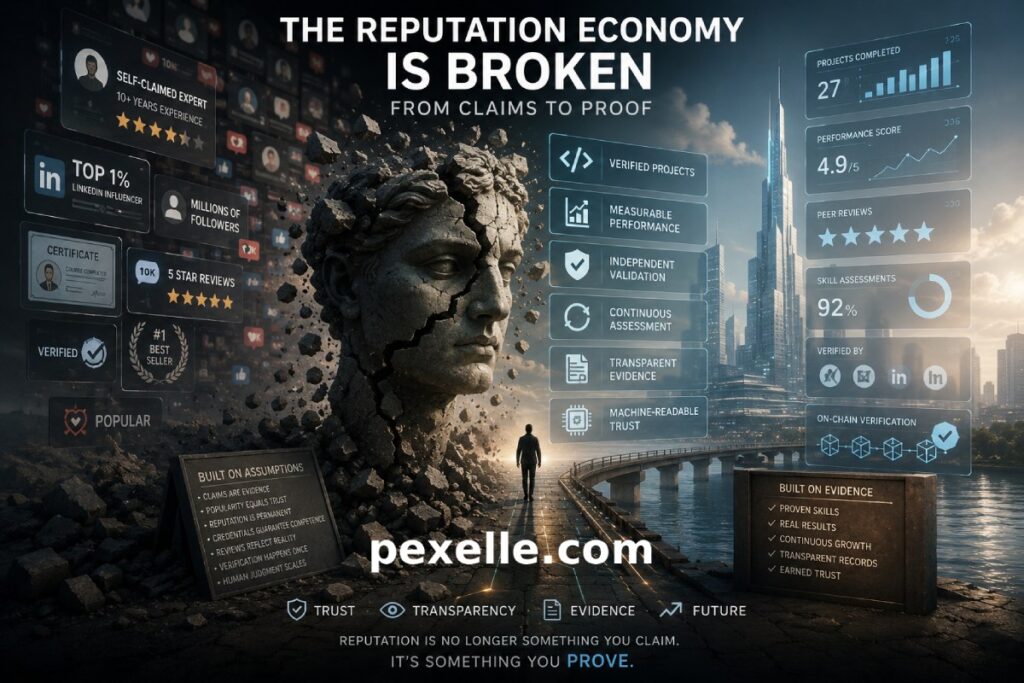
Assumption 1:
Claims Are Reasonable Evidence
Most platforms assume that if someone claims to possess a skill, experience, or achievement, it is probably true.
Examples include:
- “Senior AI Engineer”
- “10 years of experience”
- “Blockchain Expert”
- “Growth Hacker”
- “Cybersecurity Specialist”
These titles rarely require continuous verification.
A résumé may describe projects that no one has independently validated.
A LinkedIn profile may list skills endorsed by people who never worked with the individual.
Certificates often prove attendance rather than competence.
The internet has become a marketplace of self-declared expertise.
Assumption 2:
Popularity Equals Trust
Followers became a shortcut for credibility.
Large audiences often create the illusion of authority.
However, popularity measures visibility, not accuracy.
A creator with one million followers can consistently publish incorrect information.
A researcher with twenty followers may produce groundbreaking work.
Algorithms reward engagement.
Reality rewards correctness.
These are very different incentives.
Assumption 3:
Reputation Is Permanent
Many reputation systems assume that once trust has been earned, it remains valid indefinitely.
But skills evolve.
Technology changes.
Industries transform.
Someone who was an expert five years ago may no longer understand today’s tools.
Meanwhile, someone new may rapidly outperform established professionals.
Static reputation fails in dynamic environments.
Trust should decay unless it is continuously reinforced with fresh evidence.
Assumption 4:
Institutions Guarantee Competence
Degrees, certifications, and prestigious employers are often treated as proof of capability.
These credentials certainly have value.
But they represent historical achievements rather than current ability.
A university diploma cannot demonstrate how someone solves today’s problems.
Employment at a respected company does not guarantee individual excellence.
Credentials are useful context.
They should not replace measurable performance.
Assumption 5:
Reviews Reflect Reality
Online reviews have become one of the largest trust mechanisms in digital commerce.
Yet reviews suffer from multiple weaknesses:
- Fake accounts
- Purchased ratings
- Review farms
- Coordinated manipulation
- Emotional bias
- Selection bias
Many honest customers never leave reviews.
Many dishonest actors leave thousands.
The result is a noisy approximation of reality.
Assumption 6:
Verification Happens Once
Identity verification has improved dramatically.
However, identity alone proves very little.
Knowing who someone is does not prove what they can do.
The future requires continuous capability verification rather than one-time identity verification.
Who you are is only the starting point.
What you consistently demonstrate matters far more.
Assumption 7:
Human Judgment Scales
Historically, hiring managers, investors, teachers, recruiters, and customers evaluated people manually.
This worked when communities were small.
Today’s digital economy includes billions of participants.
No human can manually verify millions of claims.
AI has dramatically increased the volume of content requiring evaluation.
Manual trust no longer scales.
Evidence must become machine-readable.
AI Has Changed Everything
Artificial Intelligence introduces a fundamental shift.
Previously, creating convincing work required significant expertise.
Today AI can generate:
- Software
- Articles
- Marketing campaigns
- Research summaries
- Presentations
- Designs
- Voice recordings
- Videos
- Images
- Business plans
The cost of producing impressive-looking output approaches zero.
Consequently, appearance is becoming worthless as a trust signal.
Evidence becomes increasingly valuable.
The New Reputation Economy
Instead of asking:
“Who says they’re qualified?”
We should ask:
“What evidence supports this claim?”
Future reputation systems will likely evaluate:
Verified Projects
Real work completed under verifiable conditions.
Performance History
Objective outcomes over time.
Independent Validation
Third-party confirmations rather than self-reporting.
Continuous Assessment
Skills demonstrated repeatedly rather than once.
Transparent Evidence
Every important claim linked to supporting proof.
Machine-Readable Trust
AI systems will increasingly evaluate structured evidence instead of marketing language.
From Reputation to Proof
Imagine two candidates.
Candidate A says:
“I am an experienced software engineer.”
Candidate B provides:
- 124 verified code contributions
- 18 independently reviewed projects
- Consistent performance metrics
- Public technical assessments
- Time-stamped work history
- Verified client outcomes
The second candidate requires almost no persuasion.
Evidence replaces storytelling.
Why This Matters Beyond Hiring
The same transformation affects nearly every industry.
Healthcare requires verified competence.
Education requires demonstrated learning.
Finance requires verified credibility.
Freelancing requires measurable delivery.
Open source requires transparent contribution history.
Scientific research requires reproducible evidence.
Even social media will increasingly reward verifiable expertise over viral confidence.
The Role of AI
Ironically, AI is both the problem and part of the solution.
AI makes it easier than ever to fabricate convincing content.
At the same time, AI can analyze enormous amounts of structured evidence to evaluate consistency, authenticity, quality, and long-term performance.
Future trust systems will likely combine:
- Cryptographic verification
- Blockchain-backed records
- AI evaluation
- Human review
- Transparent audit trails
Together, these technologies can create reputation systems that are significantly harder to manipulate.
A New Definition of Reputation
For centuries, reputation was based largely on opinion.
In the coming decade, reputation will increasingly become a measurable dataset.
Not:
“I know this person.”
But:
“I can verify what this person has consistently demonstrated.”
That is a profound shift.
Trust moves from memory to evidence.
From claims to proof.
From branding to measurable performance.
Conclusion
The reputation economy is not failing because people have become less trustworthy.
It is failing because the assumptions that once supported trust no longer match the realities of a digital, AI-driven world.
Popularity is not competence.
Credentials are not continuous capability.
Claims are not evidence.
Visibility is not truth.
The next generation of digital trust will not reward those who make the strongest claims.
It will reward those who can continuously prove them.
In the age of artificial intelligence, reputation is no longer something you declare.
It is something you demonstrate, verify, and continuously earn.
Source : Medium.com