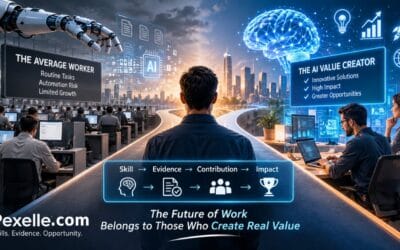

The Future of Work Is Not About Chasing Jobs. It Is About Being Recognized for What You Can Do.
Imagine a world where you no longer need to spend hours scrolling through job boards, rewriting your resume, or sending applications into a digital void.
Imagine waking up to discover that a company has already identified your skills, recognized your experience, and found a role where your abilities could make a meaningful difference.
Not because you applied.
Not because you knew the right person.
But because your capabilities were visible.
What if the future of work was not about searching endlessly for opportunities, but about opportunities finding the people who are ready for them?
This is not simply a better job-search experience. It represents a fundamental shift in how talent, work, and opportunity could connect.
The World Has Made Job Seekers Responsible for Finding Their Own Value
For decades, the traditional employment model has placed the responsibility of discovery almost entirely on individuals.
People are expected to:
- Identify suitable job openings.
- Prepare resumes tailored to specific positions.
- Navigate application systems.
- Compete against hundreds of other candidates.
- Convince employers that they possess the required capabilities.
- Repeat the process whenever their circumstances change.
The irony is that the most capable individuals are not always the most successful at navigating this process.
A talented software engineer may struggle to describe their technical abilities in the language of a job description.
An exceptional problem solver may never apply for a role because the advertised title does not reflect their actual expertise.
A professional who has developed valuable skills through years of practical experience may remain invisible because their qualifications do not match conventional expectations.
The problem is not necessarily a shortage of talent.
It is a shortage of effective ways to recognize it.
The current system often asks people to search for opportunities before it has established what they are genuinely capable of doing.
What if we reversed that relationship?
The Shift From Job Searching to Opportunity Discovery
The future of employment could be built around a different principle:
People should not have to search for every opportunity. Opportunities should be able to discover people.
In this model, professional identity would extend beyond a resume, a job title, or a list of qualifications.
Instead, it would become a dynamic representation of an individual’s capabilities.
Imagine a professional profile that continuously evolves through:
- Verified skills and competencies.
- Real-world projects and contributions.
- Demonstrated problem-solving abilities.
- Professional achievements and outcomes.
- Relevant certifications and education.
- Evidence of continuous learning.
- Recommendations and professional attestations.
This information would create a richer understanding of what someone can actually do.
Organizations could then discover individuals based on capability rather than relying exclusively on conventional recruitment filters.
A person who has never applied for a particular position could still be recognized as an excellent candidate.
A skill developed in one industry could become relevant to an entirely different sector.
A previously overlooked professional could become visible to an organization searching for precisely the abilities they possess.
The opportunity would begin with recognition, not application.
Your Job Title Is Not Your Potential
One of the biggest limitations of traditional recruitment is the assumption that professional titles accurately represent human capabilities.
But a job title is only a label.
It does not capture the full complexity of an individual’s knowledge, experience, or potential.
Consider a developer whose official title is Frontend Engineer.
Through their projects, they may have demonstrated expertise in:
- System architecture.
- Cybersecurity.
- Product strategy.
- Technical leadership.
- User experience optimization.
- Cross-functional collaboration.
Their current title might describe only a small fraction of their actual capabilities.
Now imagine an organization looking for someone to lead a new digital product.
A conventional recruitment system might search for Product Manager candidates.
A capability-based discovery system could identify this developer because their demonstrated abilities align with the organization’s actual requirements.
The individual might never have considered applying for such a position.
Yet the opportunity could be a natural extension of their experience.
The future of talent discovery will depend on how well we understand people beyond the titles they hold.
The next generation of professional platforms should recognize that a person’s potential is not limited to the role they currently occupy.
The Hidden Talent Problem
Every organization has experienced the challenge of finding the right person.
But how many organizations have failed to discover the right person because that individual was never part of the recruitment process?
The hidden talent problem exists across industries, countries, and professional communities.
It affects:
- Professionals who lack access to influential networks.
- Skilled individuals whose experience does not fit traditional career paths.
- Career changers entering unfamiliar industries.
- People with practical expertise but limited formal credentials.
- Individuals working in organizations that cannot fully utilize their abilities.
- Emerging talent that has not yet accumulated conventional professional recognition.
The world may be overlooking enormous amounts of human capability.
Traditional recruitment often begins with a vacancy and searches for people who match a predefined profile.
But a different approach could begin by understanding the available talent landscape and discovering unexpected matches.
What if an organization could identify a person whose skills are highly relevant to a challenge, even if that person has never worked in the organization’s industry?
What if an individual could be discovered for an opportunity they did not know existed?
This is where the concept of proactive opportunity discovery becomes powerful.
It transforms the employment market from a system of visible vacancies and active applicants into a more intelligent network of capabilities and emerging needs.
From Static Resumes to Dynamic Capability Profiles
A resume is fundamentally a document about the past.
It records employment history, education, achievements, and professional experiences.
Although valuable, it is often static.
A capability profile could represent something much more dynamic.
It could evolve as individuals learn, contribute, complete projects, and demonstrate new abilities.
Instead of simply stating:
“Experienced in cybersecurity.”
A professional could demonstrate:
- Security assessments completed.
- Vulnerabilities identified and resolved.
- Relevant technical competencies.
- Verified project contributions.
- Practical experience with specific technologies.
Instead of claiming:
“Strong leadership skills.”
An individual could provide evidence of:
- Teams successfully coordinated.
- Projects delivered.
- Decisions made under pressure.
- Measurable improvements achieved.
- Contributions recognized by colleagues.
The distinction is important.
A claim tells an organization what someone says they can do.
Evidence provides a foundation for understanding what they have demonstrated.
A dynamic capability profile would not eliminate the importance of resumes. It would make them part of a much richer professional identity.
The resume could become the introduction.
The capability profile could become the evidence.
And the evidence could become the foundation for opportunity.
What If Opportunity Discovery Worked in Real Time?
Imagine a future in which organizations do not simply publish job advertisements and wait for applications.
Instead, they continuously communicate the capabilities they need.
An organization developing a new cybersecurity product might require professionals with a combination of cryptography, software engineering, and risk analysis skills.
A capability discovery system could identify individuals whose demonstrated competencies align with that requirement.
A startup might need someone who has successfully built scalable systems under resource constraints.
A professional with relevant project evidence could become visible even if their current position is unrelated.
A company entering a new market might need people who understand both technical implementation and commercial strategy.
Rather than searching for a single conventional job title, the organization could discover individuals through a combination of capabilities.
The process could become:
Organizational Need → Capability Mapping → Talent Discovery → Opportunity Matching → Human Connection
This would allow opportunity discovery to become more proactive, more contextual, and potentially more effective.
The important distinction is that the system would not need to make the final hiring decision.
It would help identify relevant possibilities.
People would still evaluate the opportunity, communicate with one another, and make informed decisions.
Technology would improve discovery without replacing human judgment.
The Role of AI: Understanding Capabilities, Not Just Keywords
Artificial intelligence has the potential to transform how professional capabilities are understood.
Traditional recruitment systems frequently rely on matching keywords between resumes and job descriptions.
But human capabilities are more complex than collections of keywords.
Two professionals may use different terminology to describe similar expertise.
A skill developed in one context may be transferable to another.
A professional may possess capabilities that are not explicitly mentioned in their job title or resume.
AI-powered capability mapping could help interpret these relationships.
For example, experience in distributed systems might be relevant to blockchain infrastructure, cloud architecture, or high-availability financial platforms.
Experience managing complex construction projects could translate into operational leadership, resource coordination, and risk management.
The objective would not simply be to identify people who match a predefined list.
It would be to understand relationships between demonstrated capabilities and emerging opportunities.
However, this vision requires responsible implementation.
AI systems must not become opaque decision-makers that determine someone’s professional future.
They should help explain why an opportunity may be relevant, identify supporting evidence, and allow individuals to correct inaccurate information.
The purpose of AI should be to expand visibility, not introduce another invisible barrier.
A Future Where Career Opportunities Find You
Consider three hypothetical professionals.
1. The Engineer Who Becomes a Product Leader
An engineer has spent six years developing software systems.
Their professional profile includes verified technical contributions, architecture decisions, and evidence of collaboration with product teams.
A growing technology company is looking for a product leader who understands engineering deeply.
The engineer has never searched for Product Manager positions.
Yet their capabilities make them a compelling candidate.
An opportunity reaches them because their professional evidence reveals a potential fit.
2. The Experienced Professional Who Changes Industries
A construction professional has spent years coordinating teams, managing risks, and delivering complex projects.
A technology company is expanding its operations and needs someone with strong operational management capabilities.
Although the professional has never worked in technology, their demonstrated competencies align with the organization’s needs.
The connection becomes possible because the system recognizes transferable skills rather than relying solely on industry experience.
3. The Emerging Talent Nobody Has Discovered
A young developer has completed several complex projects but has limited formal employment experience.
Their resume is relatively short.
Their professional network is small.
However, their project evidence demonstrates strong technical capabilities.
An organization searching for emerging talent discovers their profile.
For the first time, their work becomes visible beyond the communities they already know.
These scenarios illustrate a powerful possibility:
Opportunity does not always need to follow a traditional career path.
Sometimes, it needs to recognize a different one.
The Capability Economy
As work continues to evolve, the relationship between professional identity and employment may change.
The traditional employment model often organizes people around positions, titles, and career histories.
A capability-based model could organize opportunity around demonstrated abilities, contributions, and potential relevance.
This creates the foundation for what could be described as a Capability Economy.
In this environment:
- Skills become discoverable assets.
- Evidence becomes a foundation for professional credibility.
- Contributions become signals of capability.
- Professional identity becomes more dynamic.
- Opportunities become less dependent on conventional career paths.
- Talent discovery becomes more continuous.
The value of a professional would not be determined exclusively by where they worked or what title they held.
It could also reflect what they have demonstrated, what they have contributed, and what they are capable of doing next.
This does not mean that qualifications, experience, or employment history become irrelevant.
It means they become components of a broader understanding of human capability.
The Capability Economy would make it possible to recognize value that traditional systems frequently overlook.
The Challenges We Must Solve
A future where opportunities discover people sounds promising.
But building such a system requires more than advanced matching algorithms.
Several fundamental challenges must be addressed.
Privacy and Personal Control
Professional capability data can be sensitive.
Individuals should control what information is visible, who can access it, and which opportunities they want to receive.
Being discoverable should not mean surrendering control over one’s professional identity.
Evidence Quality
Not every skill claim is accurate.
Systems must distinguish between self-reported abilities, verified credentials, demonstrated contributions, and independently assessed competencies.
Evidence should be contextualized rather than treated as an unquestionable measure of ability.
Algorithmic Fairness
AI-powered discovery could reproduce existing biases if its models rely on historical hiring patterns.
A system designed to discover overlooked talent must actively avoid reinforcing the same limitations that made that talent invisible.
Human Agency
People should not become passive recipients of algorithmically generated career recommendations.
They must be able to explore, reject, accept, and define their own professional direction.
Opportunity Transparency
Individuals should understand why an opportunity was presented to them.
A recommendation based on specific competencies and supporting evidence is more meaningful than an unexplained algorithmic suggestion.
The future of opportunity discovery must be built on trust, transparency, and individual control.
Otherwise, we risk replacing the traditional job-search problem with a new form of digital gatekeeping.
Pexelle: Building a World Where Talent Becomes Discoverable
At Pexelle, we believe the future of professional opportunity should be built around a deeper understanding of human capabilities.
The world does not lack talented people.
It lacks effective infrastructure for recognizing, validating, and connecting those capabilities with meaningful opportunities.
Pexelle is built around the idea that professional skills should become more than claims on a resume.
They should be connected to evidence, contributions, and verifiable professional identity.
By creating a more structured representation of human capabilities, Pexelle aims to help individuals make their skills visible and help organizations discover talent through a richer understanding of what people can do.
The vision extends beyond traditional job matching.
It is about creating a professional ecosystem where:
Skills become visible.
Evidence builds trust.
Contributions reveal capability.
Capabilities create opportunities.
And opportunities can reach people who might never have known where to look.
The future should not require every talented individual to become an expert in job searching.
It should create better ways for talent and opportunity to find one another.
The Future Is Not a Better Job Board
Job boards have made vacancies easier to find.
Professional networks have made connections easier to establish.
Recruitment platforms have made applications easier to process.
But the next transformation may be fundamentally different.
It may not be about improving the process of searching for jobs.
It may be about reducing the need for that search in the first place.
Imagine a professional world where your capabilities are continuously becoming more visible.
Where your achievements contribute to a living professional identity.
Where organizations can discover you based on what you have demonstrated rather than what you have applied for.
Where opportunities are not limited to the jobs you already know exist.
And where the next step in your career may emerge from a connection you never expected.
That future is not about eliminating ambition, effort, or professional development.
It is about making sure that the effort people invest in developing their abilities does not remain invisible.
Because the most important opportunity in someone’s career may not be the one they find.
It may be the one that finally finds them.
The Question That Defines the Future of Work
What if the next great career opportunity did not begin with a search?
What if it began with your capabilities being recognized?
What if opportunity found you before you searched for it?
The future of work may depend on our ability to make that possibility real.
Pexelle | Skills. Evidence. Opportunity.
Discover your capabilities. Make your professional value visible. Become discoverable.
Visit Pexelle.com and explore the future of professional identity and talent discovery.
Source : Medium.com