What Happens When a Resume Is No Longer Enough?
For decades, the resume has been the primary gateway to employment. It summarizes education, work experience, certifications, and achievements in a format that recruiters can review quickly. It has survived technological revolutions, economic shifts, and the rise of digital hiring platforms.
Yet in 2026, one question is becoming increasingly difficult to ignore:
Can we still trust resumes?
Artificial intelligence can generate polished resumes in seconds. Professional networking platforms allow users to optimize every sentence. Freelancers can purchase resume-writing services, recommendation letters, and even fabricated portfolios. While many candidates remain honest, hiring teams now spend more time verifying claims than evaluating actual talent.
The future of hiring may not be about improving resumes.
It may be about replacing them.
The Resume Was Designed for a Different Era
Traditional resumes were created for a world where:
- Employment histories were relatively stable.
- Degrees represented specialized knowledge.
- Career paths were predictable.
- Verification was expensive and slow.
Today’s workforce looks completely different.
People learn from online courses, open source projects, creator communities, hackathons, bootcamps, freelance marketplaces, and AI-assisted learning environments. Many professionals gain valuable experience long before receiving formal titles.
A single document can no longer capture dynamic skills that evolve every month.
More importantly, a resume is fundamentally a collection of claims.
Hiring teams still need evidence.
AI Changed the Meaning of Professional Profiles
Generative AI has dramatically lowered the cost of creating professional-looking documents.
Candidates can instantly generate:
- Tailored resumes
- Cover letters
- Project descriptions
- Interview responses
- Career summaries
This is not inherently dishonest.
AI helps people communicate better.
The problem appears when every candidate presents nearly perfect documentation while actual capabilities vary significantly.
As resumes become easier to optimize, they become weaker indicators of competence.
Recruiters now face an information paradox:
The documents look better than ever, while confidence in them continues to decline.
Skills Matter More Than Job Titles
A job title reveals very little about what someone can actually do.
Consider two software engineers with identical resumes.
Both worked at respected companies.
Both list similar technologies.
Both claim leadership experience.
Yet one consistently ships production systems while the other mainly maintains existing code.
The resume cannot easily communicate this difference.
Hiring increasingly depends on understanding:
- What problems someone solved
- How they solved them
- What evidence supports those claims
- Whether the work can be independently verified
The conversation shifts from “Where have you worked?”
to
“Show me what you’ve actually accomplished.”
Digital Evidence Will Replace Static Documents
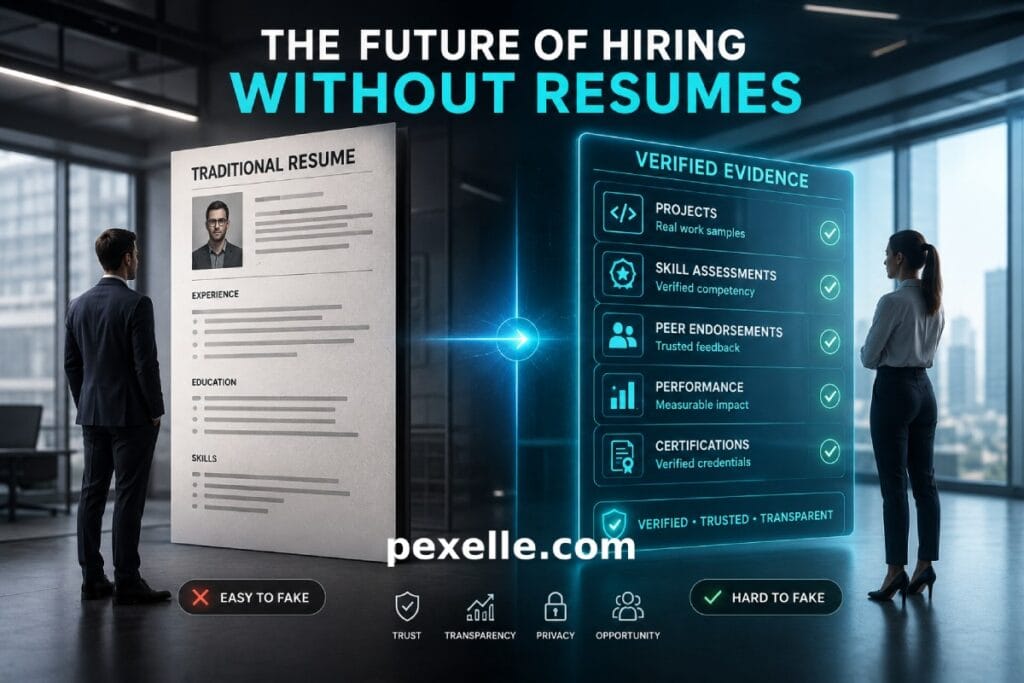
Instead of relying primarily on resumes, future hiring systems may evaluate a living portfolio of verified evidence.
This evidence could include:
- Project artifacts
- Technical assessments
- Code contributions
- Design work
- Research publications
- Peer endorsements
- Performance metrics
- Learning history
- Community participation
- Professional certifications
- Verified skill assessments
Unlike a traditional resume, these records evolve continuously.
Every completed project becomes another piece of evidence.
Verification Becomes the New Competitive Advantage
Evidence alone is insufficient.
It must also be trustworthy.
Future hiring ecosystems will increasingly focus on answering three questions:
- Who issued this credential?
- Can the evidence be verified independently?
- Has the information been altered?
Digital verification may become more valuable than traditional formatting.
Organizations will likely adopt systems that allow employers to confirm achievements instantly instead of manually contacting references.
This reduces fraud while significantly accelerating recruitment.
Reputation Will Become Portable
Today’s professional reputation is often trapped inside individual platforms.
A five-star rating on one freelance marketplace rarely transfers elsewhere.
Positive performance inside one company’s internal systems is invisible to another employer.
The future requires portable professional identity.
Workers should be able to carry verified evidence across platforms without rebuilding trust from scratch every time they apply for a new role.
Portable reputation empowers individuals while reducing repetitive verification costs for employers.
Hiring Will Become Continuous
Recruitment has traditionally been event-driven.
Someone submits a resume.
A recruiter reviews it.
Interviews begin.
A hiring decision follows.
Future hiring may become continuous instead.
Employers may maintain dynamic talent networks where candidates continuously update verified accomplishments.
Instead of searching only when vacancies appear, organizations could identify promising professionals months before positions become available.
Hiring shifts from reactive recruiting toward ongoing talent discovery.
AI Will Evaluate Evidence, Not Replace Human Judgment
Artificial intelligence will undoubtedly play a larger role in recruitment.
However, its greatest value may not lie in making hiring decisions.
Instead, AI can help organize and interpret large volumes of verified evidence.
For example, AI could:
- Summarize project histories
- Compare demonstrated skills against job requirements
- Detect missing competencies
- Highlight transferable experience
- Recommend interview questions based on evidence gaps
The final hiring decision should remain human.
AI becomes an intelligent assistant rather than the ultimate decision-maker.
Privacy Must Remain a Core Principle
As professional evidence becomes richer, protecting privacy becomes increasingly important.
Workers should control:
- Which achievements they share
- Who can view them
- How long access remains available
- Which organizations receive verification
Transparent consent mechanisms are essential.
Verification should strengthen trust without creating permanent surveillance.
The future hiring ecosystem must balance credibility with individual privacy rights.
The Resume Will Not Disappear Overnight
Resumes will likely remain part of recruitment for many years.
They are familiar, inexpensive, and universally understood.
However, their role may gradually change.
Rather than serving as the primary source of truth, resumes may become simple summaries that introduce a candidate.
The real evaluation happens through verified evidence attached to those summaries.
The resume becomes the table of contents.
The evidence becomes the book.
Beyond the Resume
The most valuable professionals of the future may not be those with the most impressive resumes.
They may be those with the strongest, most verifiable body of work.
Hiring is gradually shifting from claims to proof.
From static documents to living records.
From institutional trust to evidence-based trust.
Organizations that embrace this transition can reduce hiring risk, improve candidate quality, and make recruitment more efficient.
Professionals who build verifiable portfolios instead of polished narratives will stand out in an increasingly AI-assisted labor market.
The future of hiring is not resume-first.
It is evidence-first.
And in a world where anyone can generate convincing words, trusted proof may become the most valuable credential of all.
Source : Medium.com