The Most Valuable Economy Isn’t Measured in Dollars
Every day, billions of digital interactions happen across the internet.
People hire freelancers.
Companies recruit employees.
Creators publish content.
AI agents make decisions.
Developers contribute to open source.
Communities vote.
Businesses sign contracts.
Behind every one of these actions lies something almost impossible to quantify.
We usually think of economies as systems that exchange money.
But the modern internet is increasingly powered by something else.
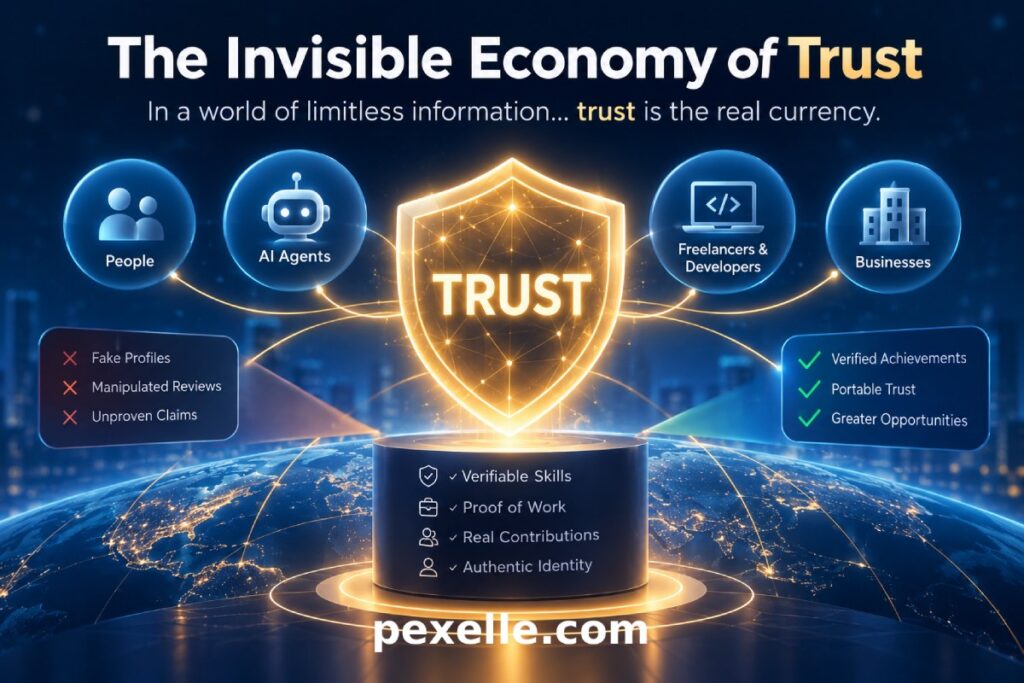
An invisible economy where trust is the real currency.
And unlike money, trust is still largely unmanaged.
That is about to change.
Trust Has Always Been an Economic Asset
Long before banks existed, civilizations traded because people trusted one another.
Merchants built reputations.
Craftsmen earned credibility.
Families passed down names that represented reliability.
Trust reduced uncertainty.
Reduced uncertainty reduced transaction costs.
Reduced transaction costs accelerated commerce.
Nothing about this principle has changed.
Only the scale has.
Today, instead of villages, we have billions of strangers interacting every second.
The challenge is no longer creating trust.
It is scaling it.
The Internet Solved Communication
The internet made information free.
Social media made publishing free.
Cloud computing made infrastructure accessible.
Artificial intelligence made knowledge abundant.
But one critical layer remained missing.
Proof.
We can instantly communicate with anyone on Earth.
Yet we still struggle to answer simple questions.
Can this person actually do what they claim?
Did they really build this product?
Did they genuinely write this article?
Is this portfolio authentic?
Is this AI generated?
Can this identity be trusted?
These questions slow every digital economy.
The Hidden Cost of Missing Trust
Most people assume the biggest cost of hiring is salary.
It isn’t.
The biggest cost is uncertainty.
Companies spend weeks interviewing candidates.
Clients ask for references.
Platforms create review systems.
Governments perform identity verification.
Banks perform compliance checks.
Every one of these exists for the same reason.
Trust is expensive.
The global economy spends enormous amounts of time verifying information that should already be verifiable.
Imagine if every online interaction required proving who you were from scratch.
In many ways, that is exactly how today’s internet works.
Reputation Is Broken
Current reputation systems were designed for a much smaller internet.
- A five star rating.
- A LinkedIn profile.
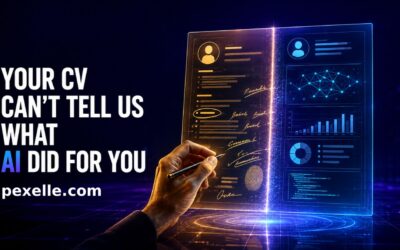
- A résumé.
Follower counts.
None of these truly prove capability.
They only suggest it.
Followers can be purchased.
Reviews can be manipulated.
Certificates can be forged.
AI can generate convincing portfolios.
The more realistic synthetic content becomes, the less valuable traditional signals become.
Reputation without proof is becoming increasingly fragile.
AI Is Accelerating the Trust Crisis
Artificial intelligence is making content production nearly free.
- Articles.
- Videos.
- Images.
- Code.
- Design.
- Music.
- Entire businesses.
Soon, millions of AI agents will negotiate, purchase, communicate, and execute tasks without human intervention.
Ironically, AI’s greatest contribution may not be automation.
It may be exposing how little we actually know about who or what we trust.
When everything can be generated instantly, originality loses value.
Authenticity becomes scarce.
Scarcity creates value.
Proof becomes the premium asset.
Trust Is Becoming Infrastructure
Electricity powers factories.
Roads power transportation.
Cloud computing powers software.
Trust will power digital collaboration.
Instead of verifying people repeatedly, future systems will verify once and reuse that trust everywhere.
Imagine a portable trust layer.
- Every completed project.
- Every verified skill.
- Every contribution.
- Every achievement.
- Every collaboration.
- Every credential.
- Every proof.
Securely owned by the individual.
Instantly verifiable by anyone with permission.
Not controlled by a single company.
Not locked inside one platform.
Simply portable trust.
This transforms trust from a platform feature into global infrastructure.
The Rise of the Trust Economy
The next generation of marketplaces will compete differently.
Not by offering more users.
But by reducing uncertainty.
The platforms that help people trust each other faster will create more economic activity than those that merely connect people.
Because confidence accelerates decisions.
- Faster hiring.
- Faster investment.
- Faster partnerships.
- Faster commerce.
Higher quality collaboration.
Trust becomes a productivity multiplier.
Human Proof Will Become More Valuable Than Human Claims
In the coming decade, the question will shift dramatically.
Today we ask:
“What can you do?”
Tomorrow we will ask:
“What can you prove?”
The difference is enormous.
Claims require belief.
Proof requires verification.
And verification scales.
The professionals who continuously build verifiable records of their work will have a significant competitive advantage over those who simply describe their experience.
Trust Creates New Forms of Capital
Traditional capital includes:
- Financial capital
- Human capital
- Social capital
- Intellectual capital
The future introduces another category.
Trust Capital.
Trust Capital represents accumulated, verifiable evidence that someone consistently creates value.
- Unlike reputation, Trust Capital is measurable.
- Unlike followers, it cannot simply be purchased.
- Unlike résumés, it continuously grows.
- Unlike platform ratings, it belongs to the individual.
The more trustworthy someone becomes, the more opportunities become accessible.
Trust itself becomes an investable asset.
Why This Matters for Everyone
This shift is not just about technology.
It affects everyone.
Students entering the workforce.
Freelancers finding clients.
Startups raising investment.
Researchers publishing discoveries.
Open source contributors.
Healthcare professionals.
Educators.
Artists.
Engineers.
Entire nations competing for global talent.
Every industry depends on trust.
The ones that digitize trust first will move faster than everyone else.
Building the Invisible Economy
The invisible economy already exists.
We simply cannot see it clearly yet.
- Every recommendation.
- Every endorsement.
- Every verified contribution.
- Every completed project.
- Every honest review.
- Every fulfilled promise.
These are transactions inside the trust economy.
What is changing is not human behavior.
It is our ability to measure and transfer trust digitally.
The organizations that recognize this shift today will define the standards of tomorrow.
Conclusion
The next wave of innovation will not come from generating more information.
It will come from making information believable.
The internet connected the world.
Artificial intelligence accelerated creation.
The next chapter belongs to verification.
Because in a world where anyone can generate almost anything, trust becomes the rarest resource.
And the rarest resource always becomes the most valuable economy of all.
The invisible economy of trust is already here.
Most people just haven’t learned how to see it yet.
Source : Medium.com