
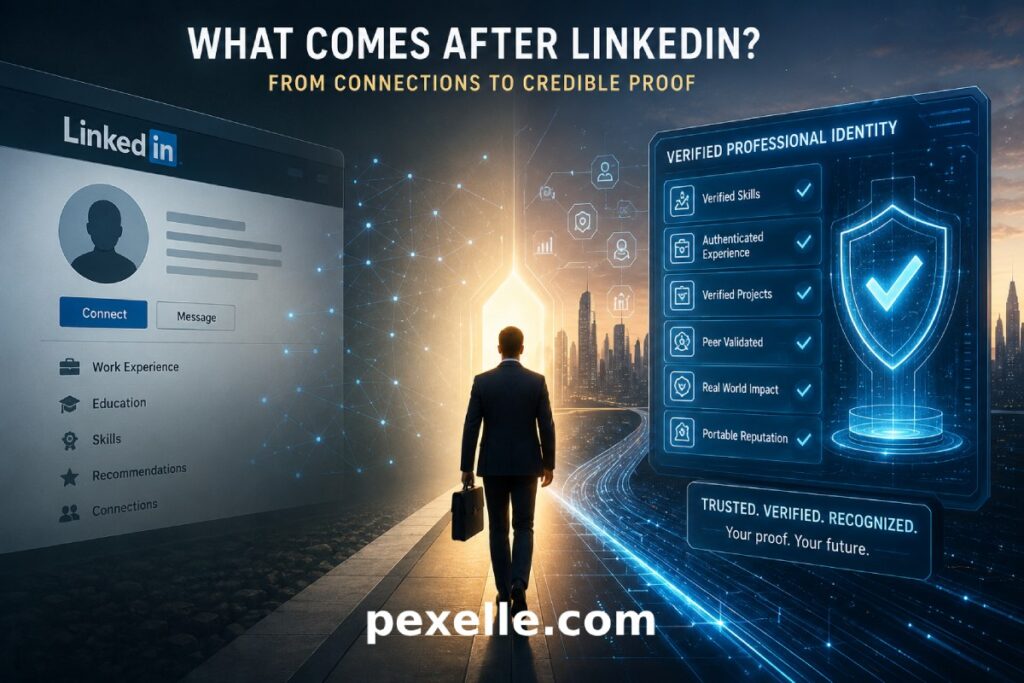
The Next Professional Network Won’t Be Built on Connections. It Will Be Built on Proof.
For more than two decades, LinkedIn has defined what it means to have a professional identity online. It gave people a place to showcase resumes, connect with colleagues, search for jobs, and build personal brands. It transformed networking from business cards into digital profiles.
But the internet has changed dramatically.
Artificial intelligence can now write resumes, generate portfolios, create certificates, produce recommendation letters, and even simulate professional conversations. As AI becomes more capable, one uncomfortable question emerges:
If anyone can generate a perfect professional profile, how do we know who is genuinely capable?
This question isn’t just about LinkedIn.
It is about the future of trust in the digital economy.
The platform that succeeds LinkedIn may not look like another social network. Instead, it may become a global infrastructure for verified reputation.
The End of Resume-Based Trust
Traditional resumes were designed for a slower world.
Employers expected to manually verify experience, references, and credentials. Skills changed gradually, and professional history was relatively easy to inspect.
Today, the situation is entirely different.
AI tools can generate:
- Professional resumes
- Cover letters
- Project descriptions
- Technical documentation
- Design portfolios
- GitHub repositories
- Marketing campaigns
- Academic papers
- Recommendation letters
Within minutes, almost anyone can appear highly qualified.
Ironically, AI is making professional profiles look better while making them less trustworthy.
The problem is no longer creating information.
The problem is believing it.
Connections Are Becoming Less Valuable
LinkedIn measures success through followers, connections, endorsements, and engagement.
These signals once carried weight because they were difficult to manufacture.
That is no longer true.
Bots create engagement.
AI generates comments.
Fake accounts inflate audiences.
Purchased followers distort influence.
Mass automation creates the illusion of authority.
The result is a network where visibility increasingly differs from credibility.
Popularity is becoming a weak proxy for competence.
Proof Becomes the New Currency
The next generation of professional identity will not ask:
“Who do you know?”
It will ask:
“What can you prove?”
Proof is fundamentally different from claims.
Claims describe what someone says.
Proof demonstrates what someone has actually accomplished.
Future professional profiles may include:
- Verified projects
- Cryptographically signed achievements
- Authenticated employment history
- Confirmed technical skills
- Peer validated contributions
- Verified educational outcomes
- Real world performance records
- Reputation earned through measurable evidence
Instead of collecting endorsements, professionals will collect proof.
Dynamic Reputation Instead of Static Profiles
Today’s professional profile is largely static.
You update it every few months.
Your actual work evolves every day.
The future profile will update continuously.
Imagine a living professional identity that automatically reflects:
- New verified projects
- Completed certifications
- Open source contributions
- AI collaboration quality
- Team performance
- Community impact
- Verified customer feedback
- Industry recognition
Professional reputation becomes a real time system instead of a digital resume.
AI Makes Verification More Important, Not Less
Many assume AI will replace professional networks.
A more likely outcome is the opposite.
AI dramatically increases the importance of verification.
As artificial intelligence produces more content, trust becomes scarcer.
Scarcity creates value.
Authenticity becomes valuable.
Verification becomes valuable.
Human reputation becomes valuable.
In an AI abundant world, proof becomes one of the rarest digital assets.
Beyond Employment
LinkedIn primarily connects professionals with employers.
The next generation platform could become infrastructure for the entire digital economy.
Imagine using one verified identity to:
- Apply for jobs
- Join investment opportunities
- Access financial services
- Participate in DAOs
- Contribute to research
- Verify freelance work
- Build startup credibility
- Unlock business partnerships
- Validate AI generated work
- Establish expertise across industries
Professional identity becomes portable.
Trust follows the individual rather than remaining inside a single platform.
Reputation as Infrastructure
The internet already has infrastructure for:
- Payments
- Communication
- Cloud computing
- Identity
- Storage
Yet it still lacks a universal infrastructure for trust.
- Every platform rebuilds reputation from scratch.
- Every marketplace starts with zero reviews.
- Every employer repeats verification.
- Every client performs due diligence.
This repetition creates enormous friction.
A universal proof layer could allow trusted achievements to travel wherever professionals go.
Instead of rebuilding credibility on every platform, reputation becomes reusable.
The Rise of the Proof Economy
We are entering what many call the Proof Economy.
In this economy:
Evidence outweighs opinions.
Verification outweighs branding.
Contribution outweighs credentials.
Consistency outweighs virality.
Trust becomes measurable.
Professional value increasingly depends not on what people claim to know, but on what independent systems can verify.
What Comes After LinkedIn?
History shows that every dominant platform eventually reaches its limits.
Email did not eliminate messaging.
Facebook did not eliminate websites.
Cloud computing did not eliminate software.
Each new layer solved a new problem.
LinkedIn solved professional discovery.
The next platform may solve professional trust.
Its core feature may not be networking.
It may be verification.
Its most valuable asset may not be user profiles.
It may be proof.
Its competitive advantage may not be attention.
It may be credibility.
Conclusion
The future of professional networking is unlikely to revolve around bigger audiences or more connections.
Instead, it will revolve around confidence.
- Confidence that skills are real.
- Confidence that experience is authentic.
- Confidence that achievements happened.
- Confidence that behind every profile is a person whose work can be independently verified.
In the age of AI, information becomes abundant.
Trust becomes scarce.
And whenever something becomes scarce, it becomes valuable.
LinkedIn built the world’s largest professional graph.
The next generation platform may build the world’s first global proof graph.
That is not simply an evolution of professional networking.
It is the foundation of the next digital economy.
Source : Medium.com