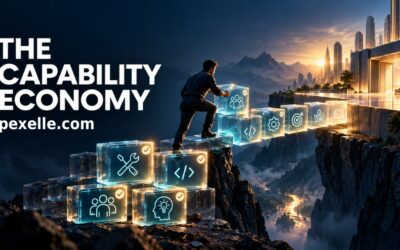

For most of history, intelligence carried a premium because it was scarce.
The ability to analyse complex information, write clearly, solve technical problems, produce original designs, or make sense of uncertainty separated highly skilled professionals from everyone else. Education, experience, and access to knowledge created barriers that took years to cross.
Artificial intelligence is rapidly lowering those barriers.
A person can now generate a business plan, translate a contract, write functioning code, analyse a dataset, or create a polished presentation in minutes. The quality is still uneven and human supervision remains essential, but the direction is unmistakable: useful cognitive output is becoming faster, cheaper, and more abundant.
This does not make humans irrelevant. It changes where human value is located.
When competent answers are available on demand, the market stops rewarding the answer alone. It begins rewarding the person who can decide which answer deserves trust, apply it in the right context, accept responsibility for the result, and prove that their contribution was real.
That shift creates a new economic and professional category: the Human Premium.
WHAT IS THE HUMAN PREMIUM?
The Human Premium is the additional value attached to qualities that cannot be produced merely by generating plausible output.
It is the value of knowing who acted, why they acted, what evidence informed the decision, and whether they will stand behind the consequences.
In an AI-rich economy, intelligence becomes infrastructure. Like electricity, cloud computing, or internet access, it remains powerful but gradually stops being a sufficient differentiator. Almost everyone can access it.
The competitive advantage moves upward, from possessing intelligence to directing it responsibly.
The most valuable professionals will not necessarily be those who can produce the most content, code, analysis, or ideas. They will be those whose work can be trusted under real conditions.
Their premium will come from a combination of trust, accountability, judgment, verified experience, context, courage, and human commitment.
1. TRUST: THE CURRENCY OF AN ABUNDANT-INTELLIGENCE ECONOMY
When content becomes cheap, verification becomes expensive.
AI can produce thousands of confident answers, but confidence is not evidence. A generated report may contain invented facts. A convincing portfolio may exaggerate the creator’s role. A perfect application may reveal very little about the applicant’s real capabilities.
As synthetic output multiplies, uncertainty about origin and reliability grows with it.
Trust therefore becomes more valuable, not less.
Employers, clients, collaborators, and communities need to know whether a person is who they claim to be, whether their evidence is authentic, and whether their past behaviour supports their promises.
Trust is not a decorative badge added to a profile. It is a record built through consistent action.
It comes from verified contributions, credible endorsements, transparent methods, and a history that can withstand scrutiny. In this environment, reputation becomes less about self-description and more about traceable proof.
The professionals who command a Human Premium will be those whose identity and track record reduce uncertainty for everyone around them.
2. ACCOUNTABILITY: SOMEONE MUST OWN THE OUTCOME
AI can recommend a strategy, draft a medical summary, identify a construction risk, or propose a software architecture.
But it cannot meaningfully accept responsibility when the recommendation causes harm.
The model does not face the client, repair the relationship, explain the decision to a regulator, or carry the moral weight of the outcome.
Accountability is the willingness to attach your identity to a decision and remain present after the output is delivered.
It means documenting assumptions, acknowledging uncertainty, escalating risks, correcting mistakes, and accepting that authority carries consequences.
As organisations automate more work, they will need clearer human ownership, not less.
Every important AI-assisted process eventually reaches a question that technology cannot answer:
Who approved this, and who is responsible for what happens next?
A professional who can say, “I reviewed this, I understand the risks, and I stand behind this decision,” provides something that no anonymous stream of generated content can supply.
That commitment is part of the Human Premium.
3. JUDGMENT: CHOOSING WELL WHEN THE ANSWER IS NOT OBVIOUS
Intelligence can generate options. Judgment determines which option fits reality.
Real decisions are rarely clean. They involve incomplete information, competing values, organisational politics, limited budgets, human emotions, legal obligations, and consequences that cannot be reduced to a prompt.
Two technically correct solutions may produce radically different outcomes depending on timing, culture, risk tolerance, or the people affected.
Judgment is the ability to recognise these hidden variables.
It includes knowing when the available data is misleading, when efficiency should not be the highest goal, when a technically elegant solution is operationally fragile, and when the correct action is to pause rather than automate.
AI can assist this process by expanding the range of possibilities and testing assumptions. But judgment depends on lived context and the ability to compare consequences that do not share a common unit of measurement.
In high-stakes environments, the most valuable person may not be the fastest producer.
It may be the person who knows what should not be done.
4. VERIFIED EXPERIENCE: PROOF BECOMES MORE VALUABLE THAN PRESENTATION
Traditional professional signals are becoming easier to imitate.
A polished CV, persuasive cover letter, attractive portfolio, and articulate interview can all be enhanced by AI. These tools can help deserving candidates communicate more effectively, but they also weaken the connection between presentation and capability.
The response cannot be to ban AI.
The stronger response is to improve the quality of proof.
Verified experience shows what a person actually contributed, under what conditions, with whom, and with what result.
It distinguishes participation from ownership and exposure from competence.
Instead of relying only on claims such as “led a project” or “expert in cybersecurity,” verified experience connects those claims to evidence:
Completed work, validated outcomes, peer confirmation, decision records, and demonstrated skills.
In the future, the strongest professional profile will not be the one with the most impressive language. It will be the one with the clearest chain of evidence.
AI may help a person perform the work, but the Human Premium comes from proving how they directed, evaluated, improved, and took responsibility for that work.
5. CONTEXT AND LIVED EXPERIENCE
AI systems learn from patterns in recorded data.
Human beings also learn from what was never formally recorded: the tense silence in a meeting, the practical workaround known only to an experienced operator, the cultural meaning behind a customer’s hesitation, or the warning signs that appear before a project fails.
This tacit knowledge is difficult to capture because it is embedded in relationships and environments.
It develops through repeated exposure, mistakes, observation, and reflection. It allows an experienced professional to notice when a situation resembles the data but differs in the one way that matters.
Lived experience should not be romanticised. Humans are biased, forgetful, and often overconfident.
Yet experience becomes powerful when it is combined with evidence, self-awareness, and AI-assisted analysis.
The future is not intuition against technology.
It is contextual human understanding strengthened by computational intelligence.
6. COURAGE, CARE, AND HUMAN COMMITMENT
Some forms of value appear only when there is something to lose.
Courage matters because a person can risk status, comfort, or opportunity by challenging a harmful decision.
Care matters because a person can choose to spend additional time protecting someone whose needs are not represented in the optimisation target.
Commitment matters because a person can remain engaged when the task becomes difficult, ambiguous, or emotionally demanding.
AI can simulate the language of empathy and generate ethical arguments. It does not possess a personal stake in the relationship.
People will increasingly distinguish between communication that sounds caring and behaviour that demonstrates care.
This distinction will matter in leadership, education, healthcare, community building, customer relationships, and every profession where trust depends on being seen, heard, and protected.
The Human Premium is not sentimentality.
It is the measurable value created when people know that another person is genuinely answerable to them.
THE NEW PROFESSIONAL DIVIDE
The major divide of the AI era may not be between people who use AI and people who do not.
It may be between people who use AI without building trust and people who use it while strengthening their credibility.
The first group will produce more.
The second group will make their production meaningful.
They will disclose how AI contributed, verify critical claims, preserve evidence of their own decisions, and build reputations that others can inspect.
Their value will not depend on pretending that every output was created without assistance. It will depend on showing what distinctly human role they played.
This changes the questions organisations should ask.
Instead of asking only, “Can this person do the task?” they should also ask:
Can we verify their role?
Do they recognise the limits of the tools they use?
Have they demonstrated sound judgment?
Will they accept responsibility?
Do other credible people trust them?
These questions reveal value that a benchmark score, generated portfolio, or polished professional profile cannot capture.
WHAT THIS MEANS FOR COMPANIES
Companies that treat AI purely as a cost-reduction tool may gain speed while quietly accumulating trust debt.
If no one can explain how decisions were made, who reviewed the output, or what evidence supports a claim, efficiency becomes fragile.
A stronger strategy is to design systems in which automation and accountability reinforce each other.
Organisations should make human ownership visible, record important decisions, verify high-impact contributions, and reward employees for responsible judgment rather than output volume alone.
Hiring and promotion systems must also evolve.
Credentials and interviews will remain useful, but they should be supported by verifiable evidence of real work.
Teams need ways to recognize the people who prevented failures, challenged weak assumptions, improved an AI-generated result, or protected users from an apparently efficient but harmful decision.
The companies that understand the Human Premium will not reject automation.
They will use it aggressively while becoming more precise about where human responsibility begins.
PEXELLE AND THE INFRASTRUCTURE OF HUMAN PROOF
The rise of the Human Premium creates a fundamental challenge for the professional world:
Valuable human qualities are often difficult to see.
Trust, judgment, accountability, and real contribution are discussed constantly, but conventional professional profiles rarely prove them.
This is where platforms such as Pexelle can play an important role.
The opportunity is not simply to create another place where people list skills. It is to build infrastructure through which skills, contributions, relationships, and professional credibility can be supported by evidence.
A verified skill should reveal more than a label.
It should connect a capability to real activity, credible validation, and context.
A professional identity should become a living record of what someone has contributed, how others experienced working with them, and where they accepted responsibility.
In an era of synthetic profiles and instantly generated claims, proof becomes a form of differentiation.
Pexelle can help move professional reputation away from assertion and toward verification, making the Human Premium visible, portable, and useful.
HOW INDIVIDUALS CAN BUILD THEIR HUMAN PREMIUM
Professionals do not need to compete with AI on speed or volume.
They need to become more valuable at the points where abundant intelligence still requires human direction.
They can begin by documenting outcomes, not just activities.
They can preserve evidence of decisions, clarify their personal contribution to collaborative work, request credible validation, and be transparent about how AI supported the process.
They can strengthen judgment by studying consequences, not merely collecting information.
They can build trust by behaving consistently when honesty is inconvenient.
The goal is not to prove that a human worked alone. In many fields, that will soon be neither realistic nor desirable.
The goal is to prove that a particular human added discernment, responsibility, context, and integrity to the work.
AI literacy will be essential.
But AI literacy without professional credibility will be easy to replace.
The durable advantage will come from combining powerful tools with a trusted identity.
CONCLUSION: THE SCARCITY IS MOVING
Intelligence is not disappearing in value.
It is disappearing in scarcity.
That distinction will reshape careers, organisations, and professional identity.
As intelligent output becomes abundant, the scarce qualities will be those that make output dependable:
Trust that has been earned.
Accountability that cannot be delegated.
Judgment formed through context.
Experience supported by evidence.
Commitment demonstrated through action.
The future will not belong simply to the smartest person in the room or to the person using the most advanced model.
It will belong to those who can turn abundant intelligence into responsible outcomes and prove the human value they contributed along the way.
That is the Human Premium.
As artificial intelligence becomes cheaper, the premium on credible humanity will continue to rise.
Source : Medium.com