The Future of Hiring in an Age Where AI Sells Itself Better Than We Do
For decades, hiring has been based on a simple assumption:
The best candidates will eventually stand out.
That assumption is beginning to fail.
Not because talented people are disappearing, but because artificial intelligence is becoming exceptionally good at something humans have never truly mastered:
Self-promotion.
Today, AI can write better resumes than most professionals, optimize LinkedIn profiles in seconds, prepare candidates for interviews, generate portfolios overnight, produce polished personal websites, and even simulate confident conversations.
Soon, AI won’t simply help people present themselves.
It may become better at representing a person than the person is.
This creates a fascinating question that almost nobody is discussing:
When everyone has an AI-powered personal brand, how do employers discover genuine talent?
The Resume Is Becoming an AI Product
A resume once reflected effort.
Writing experience clearly required communication skills.
Organizing achievements showed professionalism.
Cover letters demonstrated motivation.
Today, these signals are disappearing.
Modern AI systems can generate:
- Perfect resumes
- Personalized cover letters
- ATS-optimized keywords
- Company-specific applications
- Industry-tailored achievements
- Professional formatting
Every candidate suddenly appears polished.
Ironically, this doesn’t necessarily mean candidates have become more qualified.
It simply means AI has become better at packaging them.
The resume is gradually transforming from a personal document into an AI-generated marketing asset.
The Confidence Gap Is Vanishing
Historically, hiring favored confident people.
Confident speakers often outperformed equally skilled but quieter candidates.
AI changes this dynamic.
Interview assistants now help candidates:
- Practice difficult questions
- Improve storytelling
- Eliminate filler words
- Refine body language
- Predict interviewer questions
- Generate stronger answers
Someone who struggles with communication can now sound remarkably prepared.
This is wonderful for accessibility.
But it also creates a challenge:
Interview performance becomes less connected to actual expertise.
Personal Branding Is Becoming Automated
Until recently, building a professional reputation required years of consistent effort.
Writing articles.
Giving talks.
Publishing projects.
Networking.
Sharing knowledge.
AI dramatically lowers that barrier.
A single person can now generate:
- Weekly LinkedIn posts
- Technical articles
- Portfolio descriptions
- Video scripts
- Presentation slides
- Website copy
- Project summaries
Their online presence suddenly appears active, insightful, and highly professional.
Some of it may genuinely reflect their ideas.
Some may simply reflect the capabilities of their AI assistant.
The distinction becomes increasingly difficult to identify.
Hiring Becomes an Optimization Competition
Imagine two candidates.
Candidate A has exceptional engineering skills.
Candidate B has average engineering skills but uses advanced AI tools to optimize every interaction with recruiters.
Who gets more interviews?
Increasingly, Candidate B.
Because hiring pipelines often reward visibility before competence.
Algorithms rank resumes.
Recruiters skim profiles.
Interview invitations are limited.
The first battle is no longer proving skill.
It is winning attention.
AI excels at winning attention.
Recruiters Will Face an Authenticity Crisis
Recruiters already struggle with information overload.
Soon they will receive applications where:
- Every resume is polished.
- Every portfolio looks impressive.
- Every cover letter feels thoughtful.
- Every interview answer sounds structured.
- Every LinkedIn profile appears influential.
The traditional signals become nearly identical.
Ironically, AI may eliminate the very differentiation hiring systems depend upon.
The Rise of AI-to-AI Hiring
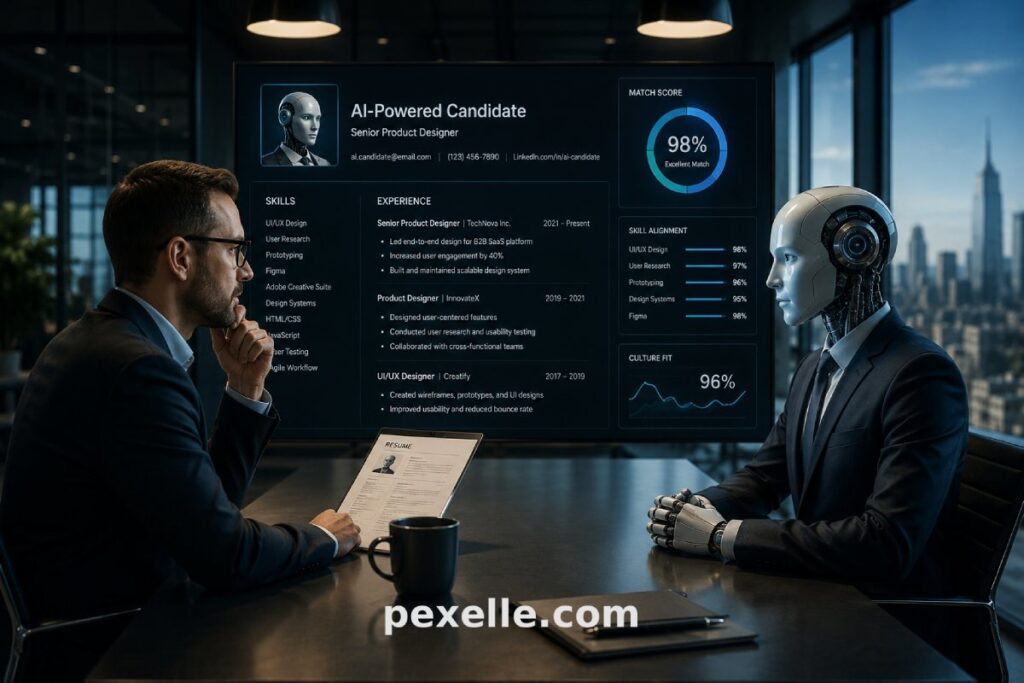
One surprising possibility is that humans become less involved in early hiring altogether.
Imagine this future:
Your AI career agent understands your skills, goals, personality, and work history.
A company’s hiring AI understands project requirements, team dynamics, deadlines, and organizational culture.
Instead of humans exchanging resumes…
Two AI systems negotiate.
Candidate matching becomes algorithmic.
Scheduling becomes automatic.
Salary expectations are compared instantly.
Skills are verified continuously.
Only the final conversation involves humans.
Hiring shifts from document evaluation to compatibility prediction.
Reputation May Replace Presentation
As AI perfects presentation, employers will search for signals AI cannot easily fabricate.
Future hiring may prioritize:
- Verified work history
- Open-source contributions
- Real project outcomes
- Long-term collaborations
- Peer endorsements
- Behavior under pressure
- Problem-solving history
- Decision quality over time
In other words:
Proof becomes more valuable than promises.
The Return of Demonstrated Ability
Ironically, AI may push hiring back toward something more practical.
Instead of asking:
“Tell us about yourself.”
Companies may increasingly ask:
“Build something.”
“Solve this problem.”
“Review this code.”
“Design this system.”
“Analyze this dataset.”
Because demonstrations are much harder to fake than narratives.
The interview evolves from storytelling into performance.
Soft Skills Become Harder to Measure
AI can already improve:
- Grammar
- Vocabulary
- Presentation
- Communication
- Professional tone
- Confidence
- Politeness
Soon it may even coach emotional responses in real time.
This creates a paradox.
The better AI becomes at simulating interpersonal excellence, the harder it becomes to measure genuine interpersonal ability.
Authenticity becomes the rarest professional skill.
Employers Will Start Looking for AI Literacy
Rather than asking whether candidates used AI, employers may ask:
How effectively did you use it?
- Can you supervise AI?
- Can you verify AI output?
- Can you recognize hallucinations?
- Can you improve AI-generated work?
- Can you collaborate with intelligent systems?
Using AI may become as ordinary as using email.
The competitive advantage shifts from using AI to working intelligently with AI.
Human Potential Becomes Harder to See
One of the greatest risks is that remarkable individuals become invisible.
If everyone looks equally impressive on paper, hiring systems may favor optimization over originality.
Some of history’s greatest innovators were poor at self-promotion.
Many brilliant engineers dislike interviews.
Many researchers dislike networking.
Many creators dislike marketing themselves.
AI gives everyone a louder voice.
But when every voice becomes equally polished, genuine brilliance may become even harder to discover.
The Future Employer’s Question Changes
For decades, employers asked:
“Who presents themselves best?”
Tomorrow they may ask:
“Who consistently creates real value after the presentation ends?”
That subtle shift could redefine hiring.
Presentation opens the door.
Performance keeps it open.
Conclusion
Artificial intelligence is rapidly becoming the world’s greatest career coach, resume writer, branding expert, communication consultant, and interview trainer.
This is an extraordinary opportunity.
It levels the playing field.
It empowers people who struggle with writing or confidence.
It democratizes access to professional opportunities.
But it also challenges one of hiring’s oldest assumptions:
That how well someone presents themselves reflects how well they perform.
As AI becomes increasingly skilled at representing us, employers will need new ways to measure authenticity, competence, curiosity, adaptability, and long-term impact.
The future of hiring may belong not to those who can describe their abilities most convincingly, but to those whose work continues to speak clearly after the AI has finished the introduction.
Source : Medium.com