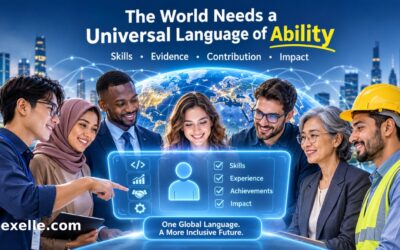

Why does moving to another country often force talented professionals to prove their abilities all over again?
Pexelle | The Future of Professional Identity, Skills & Verifiable Human Capability
Introduction: A New Country Shouldn’t Mean a New Beginning
Imagine spending fifteen years building a professional career.
You have earned qualifications, managed teams, delivered complex projects, solved difficult problems, developed specialized expertise, and built a reputation within your industry.
Then you move to another country.
Suddenly, your professional identity seems to disappear.
Your previous job title carries less weight. Your qualifications require additional assessment. Your experience is questioned. Employers ask for local references. Recruiters struggle to understand your previous responsibilities. Even skills that were highly valued in your home country may need to be explained from scratch.
You are still the same professional. You have the same knowledge, the same experience, and the same ability to deliver results.
But the system evaluating you may see someone it does not yet recognize.
This creates one of the most overlooked problems in the modern global workforce: professional experience does not travel as easily as people do.
International mobility has become a normal part of modern careers. Professionals relocate for better opportunities, safety, education, family, economic stability, and personal growth. Companies increasingly recruit across borders, and remote work has made international collaboration more accessible than ever.
Yet professional recognition remains heavily dependent on geography.
A career built over fifteen years can become difficult to interpret simply because its evidence was created in another country.
The question is no longer whether people can move internationally.
It is whether their professional identity can move with them.
1. The Invisible Career Reset
For many immigrants, changing countries creates an unexpected professional reset.
This reset does not necessarily happen because their skills have become outdated or their experience is insufficient. It happens because the institutions, employers, and professional networks in the destination country may not have enough information to evaluate their previous achievements.
Consider a software engineer who has spent ten years developing enterprise systems in another country.
They may have:
- Designed complex software architectures.
- Led engineering teams.
- Managed production environments.
- Delivered large-scale technical projects.
- Mentored junior developers.
- Worked with international clients.
After relocating, they may find themselves applying for positions that require significantly less responsibility.
Why?
Because their previous professional history is not immediately recognizable to local employers.
Their experience exists, but the evidence supporting it is unfamiliar.
This distinction matters.
There is a difference between lacking professional capability and lacking locally recognizable proof of that capability.
Unfortunately, recruitment processes sometimes treat these two situations as if they were the same.
The result is an invisible career reset: professionals must rebuild the credibility they already spent years earning.
2. Your Experience Is Real, But Is It Recognizable?
One of the biggest barriers facing internationally mobile professionals is the difference between having experience and having experience that another organization can easily understand.
A professional might have an impressive portfolio, multiple qualifications, and years of employment history. However, employers in another country may struggle to interpret the meaning of those achievements.
A job title in one country does not always correspond to the same responsibilities in another.
A qualification may have a different structure, recognition status, or level of professional accreditation.
A company that was well respected in one market might be completely unknown in another.
Even professional references can become difficult to verify because they are located in another jurisdiction, speak another language, or use different employment verification systems.
This creates a credibility gap.
The professional knows what they can do. Previous employers may know what they accomplished. But the new employer has to make a decision using evidence that may be difficult to interpret.
The problem is not necessarily the quality of the professional.
It is the lack of a shared language for professional credibility.
In a global labour market, experience needs to become understandable beyond the environment in which it was originally developed.
3. Qualifications Are Not the Same as Capability
Educational qualifications play an important role in professional evaluation.
They provide evidence of formal learning, structured knowledge, and academic achievement.
However, they do not tell the entire story of a person’s professional ability.
A university degree earned ten years ago cannot independently demonstrate everything someone has learned through subsequent employment.
Likewise, a professional qualification from another country does not automatically reveal the complexity of projects someone has managed or the practical problems they have solved.
Consider two professionals:
One has a locally recognized qualification but limited practical experience.
The other has spent twelve years delivering successful projects internationally but holds a qualification that is unfamiliar to local employers.
A recruitment system that places excessive emphasis on familiar credentials may overlook the second candidate.
This does not mean qualifications should be ignored. Certain professions, including medicine, engineering, and other regulated occupations, have legitimate licensing and registration requirements.
But professional recognition should distinguish between two separate questions:
- Does this person meet the formal requirements to practise in this country?
- What can this person actually do, based on their demonstrated skills and experience?
These questions are related, but they are not interchangeable.
A person may need additional local certification while still possessing significant transferable professional capabilities.
Recognizing that distinction could prevent employers from overlooking valuable international talent.
4. The Hidden Cost of Starting Again
When professionals are unable to transfer their experience effectively, the consequences extend far beyond finding a job.
The impact can affect their income, confidence, career progression, financial stability, and long-term professional development.
A senior professional might accept an entry-level position simply to gain local experience. An experienced manager might return to an individual contributor role. A specialist might spend years trying to obtain recognition for qualifications that were already sufficient to establish their expertise elsewhere.
The consequences are significant.
According to the OECD’s International Migration Outlook 2026, around 33% of tertiary-educated foreign-born workers in OECD countries are employed in occupations below their qualification level, compared with 24% of tertiary-educated native-born workers.
This is not simply an individual career problem. It represents an economic loss.
Countries invest resources in attracting international talent, yet their labour markets do not always make effective use of the capabilities those people bring.
Businesses may spend additional time recruiting and training when qualified professionals are already available.
And individuals who have spent years developing valuable expertise may find themselves rebuilding careers instead of contributing at their full potential.
There is also a psychological dimension.
Starting again can gradually weaken professional confidence. People may begin questioning their own abilities, even when the real problem is that their experience is not being properly recognized.
Over time, some professionals stop pursuing opportunities that match their previous level of expertise.
They adapt their expectations to the limitations of the system.
But adaptation should not require abandoning an entire professional identity.
5. Local Experience: A Requirement That Can Become a Barrier
One of the most frustrating phrases internationally mobile professionals encounter is:
“We are looking for someone with local experience.”
There are legitimate reasons employers value local experience.
Knowledge of national regulations, customer expectations, workplace practices, communication standards, and industry-specific requirements can be important.
However, local experience is sometimes used as a shortcut for evaluating trust.
An employer may feel more comfortable hiring someone whose previous work is familiar, whose references are easy to contact, and whose professional history follows recognizable local patterns.
The difficulty begins when familiarity becomes more important than demonstrated competence.
For example, an experienced project manager who has successfully delivered international infrastructure projects may be overlooked because they have not managed a project in the destination country.
But the ability to manage budgets, coordinate teams, identify risks, negotiate with stakeholders, and deliver projects does not automatically disappear at a national border.
Some aspects of a job are country-specific. Others are transferable.
A better recruitment process would identify both.
Instead of asking whether someone has previously worked locally, employers could ask:
- Which responsibilities has this person successfully managed?
- What measurable outcomes have they delivered?
- Which professional skills can transfer directly?
- Which local requirements genuinely need additional training?
- What evidence supports their ability to perform this role?
This approach would make local experience a relevant consideration rather than an automatic barrier.
6. The Problem With Traditional CVs in a Global Workforce
The traditional CV was designed to summarize a person’s professional history.
It typically contains job titles, employers, qualifications, dates, responsibilities, and selected achievements.
It remains useful, but it has limitations.
A CV is largely a self-reported document. It tells employers what candidates claim to have done, but it does not independently establish the authenticity or depth of every listed capability.
This becomes particularly challenging when someone applies for a job in another country.
The employer may not recognize previous companies, understand unfamiliar job titles, or know how to evaluate qualifications issued by foreign institutions.
A CV also struggles to represent the full range of skills developed throughout a career.
Someone who worked as a technical manager might have acquired expertise in:
- Software architecture.
- Business strategy.
- Risk management.
- Team leadership.
- Stakeholder communication.
- Financial planning.
- Technical delivery.
Yet their job title may communicate only a fraction of these capabilities.
The problem becomes even greater when professional responsibilities differ between countries.
Two people may have identical job titles but completely different levels of responsibility. Conversely, two professionals with different job titles may perform almost identical work.
A globally mobile workforce needs something more flexible than a document organized primarily around employment history.
It needs a way to represent professional capability independently of geography, employer, and job title.
7. Skills Are More Portable Than Job Titles
A job title is often meaningful within a particular company, industry, or national labour market.
A skill is more transferable.
Consider a professional who has worked as an Operations Manager in one country and moves to another.
The new employer might not recognize the previous company or understand the exact meaning of that job title.
But the underlying capabilities can be described and evaluated:
- Operational planning.
- Process optimization.
- Resource allocation.
- Performance management.
- Problem-solving.
- Team development.
- Risk assessment.
These capabilities are not tied to one employer or one geographical location.
They can be relevant across different industries and national markets.
This creates an important opportunity to rethink professional identity.
Instead of defining people primarily by where they worked and what their position was called, professional profiles could focus on what they know, what they can do, and what they have demonstrated.
A skills-based approach does not eliminate the importance of experience or qualifications.
It makes them part of a broader picture.
A career should be understood through the capabilities a person has developed, not just the locations where those capabilities were acquired.
8. Evidence-Based Professional Identity: A Better Way Forward
If professional experience is difficult to transfer between countries, the next question is obvious:
How can professionals make their capabilities easier to understand, verify, and recognize internationally?
One promising direction is evidence-based professional identity.
Instead of relying exclusively on a CV or a list of qualifications, professionals could build a structured record of their skills and connect those skills to supporting evidence.
For example, a software developer could demonstrate technical capabilities through verified project contributions, professional assessments, code portfolios, and employer attestations.
A project manager could provide evidence of successfully delivered projects, verified responsibilities, leadership experience, and measurable outcomes.
A designer could connect specific competencies to completed work, client feedback, and independently assessed skills.
This changes the nature of professional evaluation.
Rather than asking candidates to repeatedly explain their previous careers, employers can access a clearer picture of what those individuals have demonstrated.
Such a system could include several important components:
1. Verifiable skills
Skills should be represented in a structured format, with clear definitions and identifiable levels of proficiency.
2. Evidence of achievement
Professional capabilities should be connected to real projects, assessments, contributions, or documented outcomes.
3. Trusted attestations
Employers, educational institutions, professional associations, and verified experts should be able to confirm relevant achievements.
4. Transferable professional records
A person’s professional identity should remain accessible when they change employers, industries, or countries.
5. Continuously updated capabilities
Skills should evolve alongside professional development. A career record should reflect new knowledge, recent achievements, and changing levels of expertise.
The objective is not to create another digital CV.
It is to establish a more reliable representation of professional capability.
9. Technology Can Make Professional Identity Borderless
Technology has already transformed how people communicate, collaborate, learn, and work across international boundaries.
A software engineer in New Zealand can contribute to a project in Germany. A designer in Canada can work with a company in Singapore. A business consultant in the United Kingdom can advise clients in the Middle East.
Professional collaboration is becoming increasingly global.
Yet the systems used to establish professional credibility have not evolved at the same pace.
Digital professional identity could help close this gap.
Imagine a future in which professionals maintain a portable record of their capabilities throughout their careers.
When they move to another country, they do not need to reconstruct their entire professional history.
Instead, they can present a structured profile containing:
- Verified professional skills.
- Recognized qualifications and certifications.
- Evidence of completed projects.
- Confirmed employment history.
- Professional endorsements and attestations.
- Practical assessments of their abilities.
- Contributions to professional communities.
An employer in a new country could evaluate this information without depending entirely on unfamiliar job titles or locally established professional networks.
Importantly, this would not mean that every country must accept every foreign qualification automatically.
Professional licensing, immigration requirements, safety standards, and local regulations would still apply.
Technology cannot replace legitimate professional standards.
But it can make the evidence needed to evaluate a person’s capabilities more accessible, understandable, and portable.
The International Labour Organization has also highlighted that skills must be transferable and recognized, supported by trusted sources of information, for migrant workers to demonstrate their capabilities across labour markets.
The opportunity is to make professional recognition less dependent on geographical familiarity.
10. What Employers and Countries Need to Change
Creating a more internationally accessible labour market requires changes from more than just technology providers.
Employers, governments, educational institutions, and professional organizations all have a role to play.
For employers: Evaluate capabilities, not familiarity.
Recruitment teams should distinguish between skills that genuinely require local knowledge and capabilities that can be transferred from international experience.
A candidate should not automatically be considered less qualified because their previous employer operated in another country.
For governments: Improve recognition pathways.
Qualification recognition processes should be transparent, accessible, and proportionate to the requirements of each profession.
Where additional local training or licensing is necessary, professionals should have clear pathways to complete it.
For educational institutions: Make qualifications easier to understand internationally.
Standardized descriptions of learning outcomes, competencies, and qualification levels can help employers understand what a person has actually studied and achieved.
For professional organizations: Support portable evidence.
Professional bodies can help establish consistent competency standards and provide trusted verification of relevant professional achievements.
For professionals: Build evidence throughout their careers.
People should not wait until they migrate to organize their professional history.
Documenting projects, achievements, certifications, assessments, and professional contributions creates a stronger foundation for future career opportunities.
These changes would help reduce unnecessary repetition in professional evaluation while preserving legitimate standards of quality and accountability.
11. The Future of Careers Is Not Geographical
For decades, professional identity has been closely connected to physical locations.
People studied in one country, entered a local labour market, developed professional relationships, and established reputations within familiar institutions.
Moving elsewhere often meant entering a completely different professional environment.
But the modern economy is changing this model.
Knowledge travels instantly. Projects involve international teams. Companies recruit globally. Professional communities extend beyond national borders.
The value of an individual’s contribution increasingly depends on what they can demonstrate rather than where they happen to live.
This does not mean geography has become irrelevant.
Local laws, cultural understanding, language, professional licensing, and market knowledge remain important.
However, these factors should not erase transferable professional capabilities.
An experienced engineer does not lose engineering knowledge when crossing a border.
A skilled entrepreneur does not lose business experience when relocating.
A talented designer does not lose creative ability because their previous clients were based in another country.
Their professional context changes.
Their underlying capabilities do not automatically disappear.
The future of work requires a better distinction between what must be learned locally and what has already been demonstrated globally.
12. Pexelle’s Perspective: Your Professional Identity Should Travel With You
At Pexelle, we believe professional identity should not be limited to a job title, a CV, or the geographical boundaries of a labour market.
A person’s career is the accumulation of skills, knowledge, experience, contributions, and demonstrated achievements.
These elements should remain connected throughout their professional journey.
This is why a more evidence-based approach to professional identity matters.
The traditional employment model often asks people to repeatedly prove who they are and what they can do.
We believe the future should move towards a system in which professional capabilities can be demonstrated, verified, and understood across organizations and borders.
Imagine developing a professional identity that evolves with you.
You acquire a skill, demonstrate it through practical work, receive independent recognition, and add evidence of your contribution.
Later, when you change employers or move to another country, that professional history remains part of your identity.
Your next employer does not have to rely exclusively on an unfamiliar job title or an unfamiliar company name.
They can evaluate the capabilities you have demonstrated.
This is the foundation of a more transparent and evidence-driven professional ecosystem.
At Pexelle, our vision is built around connecting:
Skill → Evidence → Contribution → Impact
Because professional credibility should grow with your experience, not disappear when your circumstances change.
A career is not a collection of jobs tied to different countries.
It is a continuously developing record of human capability.
Conclusion: You Changed Countries, Not Your Capabilities
Moving to another country is already a significant life transition.
Professionals must adapt to new cultures, regulations, communication styles, labour markets, and personal circumstances.
They should not also have to rebuild their entire professional identity simply because their previous experience is unfamiliar to a new employer.
Recognition systems need to evolve alongside international mobility.
Qualifications still matter. Local experience can be valuable. Professional standards must be protected.
But none of these should prevent employers from recognizing genuine, transferable capabilities.
The next generation of professional infrastructure should make skills easier to demonstrate, achievements easier to verify, and professional identities easier to carry across borders.
Because a person’s career should not start from zero every time they move.
Your experience has value beyond the country where you earned it.
Your skills should travel with you. Your professional identity should too.
Pexelle
Your Skills. Your Evidence. Your Future.
Source : Medium.com