
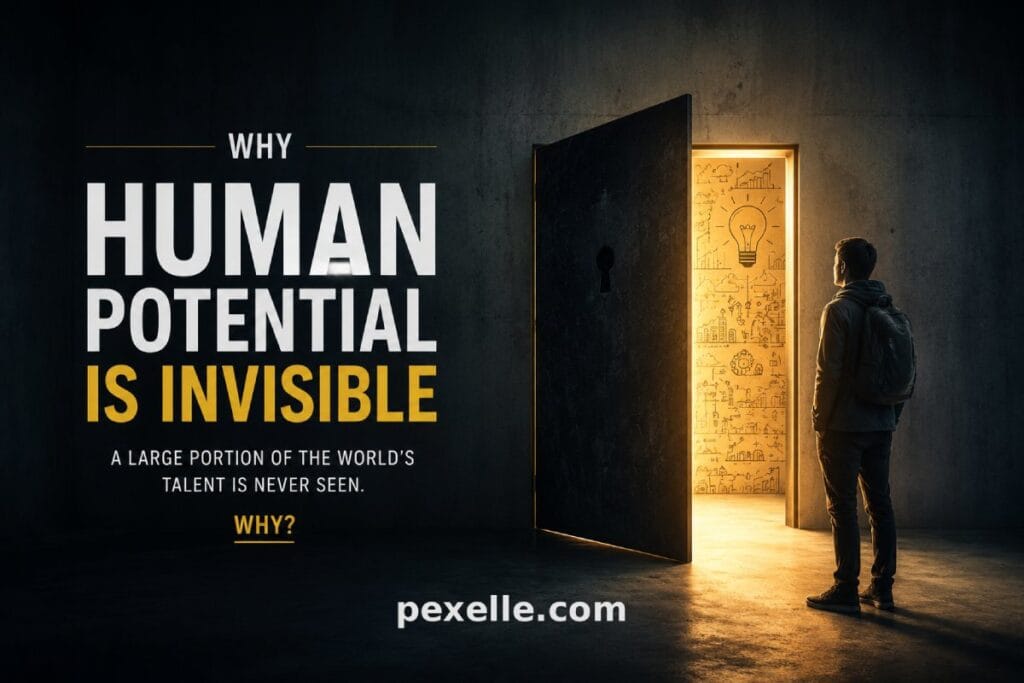
A Large Portion of the World’s Talent Is Never Seen
Why?
Not because people lack ability.
Not because they lack intelligence.
Not because they lack ambition.
The uncomfortable truth is that human potential is often invisible long before it has a chance to become visible.
Every year, millions of people with extraordinary capabilities remain unnoticed. Brilliant thinkers work in ordinary jobs. Natural leaders never receive leadership opportunities. Inventors never build. Artists never create. Entrepreneurs never launch.
The world is not suffering from a shortage of talent.
It is suffering from a shortage of visibility.
Potential Is Not Performance
One of the biggest misconceptions in modern society is the belief that performance and potential are the same thing.
Performance is what people have already demonstrated.
Potential is what they could become under the right conditions.
The problem is that most systems reward evidence, not possibility.
Employers hire based on experience.
Investors fund based on traction.
Universities admit based on scores.
Platforms promote based on engagement.
As a result, people who have already succeeded become more visible, while those who have not yet been given a chance remain hidden.
Potential often exists before proof.
But most systems only recognize proof.
Geography Still Determines Opportunity
Talent is evenly distributed.
Opportunity is not.
A gifted software developer born in Silicon Valley and a gifted software developer born in a remote village may possess similar abilities.
Yet their paths can be dramatically different.
Access to education, mentors, networks, capital, technology, and information still depends heavily on location.
The internet reduced this gap, but it did not eliminate it.
Many people never reach environments where their capabilities can be discovered.
Their potential remains buried beneath circumstances they did not choose.
The Visibility Problem
Modern society often mistakes visibility for competence.
People with large audiences are assumed to be experts.
People with strong personal brands are assumed to be leaders.
People who communicate confidently are assumed to be highly capable.
Yet visibility and ability are not the same thing.
Many highly capable individuals remain invisible because they are introverted, lack resources, live in underserved regions, or simply do not know how to market themselves.
At the same time, visibility can amplify average talent into apparent excellence.
The world frequently rewards what it can see rather than what truly exists.
Untapped Potential Requires Environment
A seed contains a forest.
But only under the right conditions.
Human potential works the same way.
Potential is not a guarantee.
It is a possibility.
Without encouragement, education, support, resources, and opportunities, extraordinary abilities may never emerge.
History is filled with stories of individuals whose talents appeared only after encountering the right mentor, team, challenge, or environment.
The tragedy is not that potential sometimes fails.
The tragedy is that much potential never gets the chance to try.
Fear Keeps Talent Hidden
Many people never reveal their capabilities because they fear failure, rejection, criticism, or uncertainty.
Potential often requires risk.
- A future entrepreneur must risk launching.
- A future writer must risk publishing.
- A future leader must risk speaking.
- A future innovator must risk being wrong.
The safest path is often invisibility.
But invisibility comes with its own cost.
A world where people hide their potential becomes a world that loses innovation, creativity, and progress.
Systems Are Designed to Measure the Wrong Things
Most evaluation systems are optimized for efficiency, not discovery.
Schools measure memorization.
Recruiters scan resumes.
Algorithms reward engagement.
Organizations track short term performance.
These systems can identify proven ability, but they often struggle to identify hidden potential.
The next great founder may have no impressive resume.
The next breakthrough scientist may be unknown.
The next transformative leader may currently be overlooked.
Potential rarely arrives with credentials attached.
Technology Creates New Possibilities
For the first time in history, technology offers a chance to make hidden talent more visible.
A creator can reach a global audience.
A developer can contribute to open source projects.
An entrepreneur can launch a business from anywhere.
An expert can share knowledge online.
Artificial intelligence is accelerating this trend by lowering barriers to creation, learning, and distribution.
The future may belong not only to those with talent, but to those who can demonstrate it regardless of location or background.
Technology cannot create potential.
But it can reveal it.
The Greatest Waste in the World
When people think about waste, they imagine wasted money, wasted resources, or wasted time.
Yet the greatest waste may be invisible human potential.
Ideas that were never shared.
Companies that were never built.
Solutions that were never discovered.
Leaders who were never given a chance.
Talents that remained hidden for a lifetime.
Every unseen capability represents a loss not only for the individual but for society itself.
Conclusion
Human potential is invisible because it exists before evidence.
It lives beneath circumstances, behind fear, beyond geography, and outside traditional measurement systems.
The challenge of the future is not merely creating more talent.
It is discovering the talent that already exists.
Somewhere today, an unknown innovator is working an ordinary job.
An undiscovered artist is creating in silence.
A future founder is waiting for an opportunity.
A transformative idea exists only in someone’s imagination.
The world’s greatest opportunities may not be hidden in the next technology, market, or invention.
They may be hidden inside people who have simply not been seen yet.
Source : Medium.com