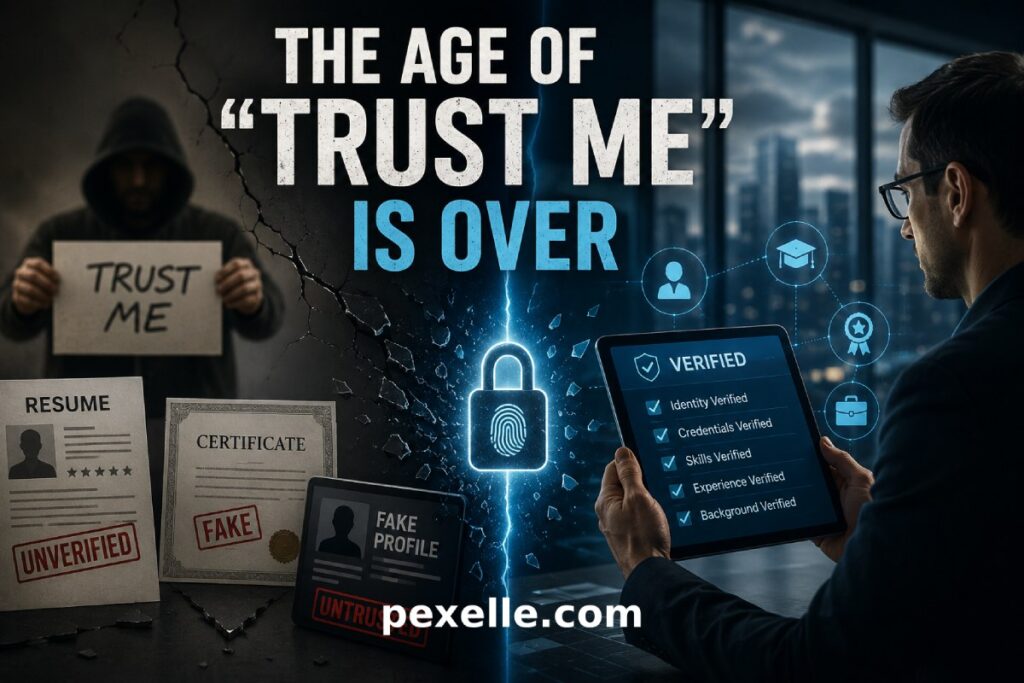
Trust Is No Longer a Promise. It Must Be Proven.
For centuries, societies have been built on a simple phrase:
“Trust me.”
- Employers trusted resumes.
- Customers trusted brands.
- Governments trusted documents.
- Investors trusted founders.
- Universities trusted transcripts.
- Communities trusted reputation.
For generations, these signals were sufficient because verifying every claim was slow, expensive, or simply impossible.
That era is ending.
Artificial intelligence, deepfakes, digital identity fraud, and automated content generation have fundamentally changed the economics of trust. Today, anyone can generate convincing resumes, fake certificates, synthetic voices, AI-written reports, realistic profile photos, and even entire online identities within minutes.
The problem is no longer creating information.
The problem is believing it.
Welcome to the era where proof matters more than promises.
The Trust Crisis Nobody Prepared For
Every digital interaction starts with an assumption.
Is this person real?
Did they actually create this work?
Do they truly possess these skills?
Can this company deliver what it claims?
Did this event actually happen?
For decades we accepted indirect signals as evidence:
• Degrees
• References
• Reviews
• LinkedIn profiles
• Company logos
• Social media followers
These signals were never perfect.
Today they are becoming increasingly unreliable.
When AI can produce professional-looking content at virtually zero cost, appearance loses value.
Verification becomes everything.
AI Didn’t Break Trust
It Exposed Its Weakness
Many people argue that AI is destroying trust.
In reality, AI is revealing that our trust systems were already fragile.
- A resume was always just a document.
- A recommendation letter was always someone’s opinion.
- A certificate was only valuable because people believed it.
AI simply makes it dramatically easier to imitate these signals.
The underlying weakness always existed.
Now everyone can see it.
Every Industry Is Becoming a Verification Problem
The next decade will not be defined only by AI adoption.
It will be defined by verification infrastructure.
Healthcare needs verified professionals.
Education needs verified learning.
Recruitment needs verified skills.
Finance needs verified identities.
Supply chains need verified origins.
Insurance needs verified evidence.
Media needs verified authenticity.
Governments need verified citizens.
Every digital ecosystem increasingly depends on answering one question:
Can this information be trusted?
Reputation Alone Is No Longer Enough
Brand reputation remains valuable.
But reputation without evidence is becoming fragile.
Customers increasingly expect transparency.
Employees expect measurable achievements.
Investors expect validated metrics.
Partners expect auditable claims.
The companies that thrive will not simply make better promises.
They will make claims that anyone can independently verify.
This represents one of the biggest shifts in modern business.
The Rise of Proof-Based Economies
History has already shown us this transition.
Cash became digital transactions.
Paper maps became GPS.
Physical signatures became cryptographic signatures.
Ownership became blockchain records.
Communication became instant messaging.
Now trust itself is becoming programmable.
Instead of saying:
“I completed this project.”
People will provide immutable proof.
Instead of saying:
“I have these skills.”
Professionals will provide verified evidence.
Instead of saying:
“Our platform is secure.”
Companies will expose measurable security metrics.
Trust is moving from subjective belief toward objective validation.
Verification Will Become Invisible Infrastructure
The most powerful technologies often disappear into the background.
People rarely think about SSL certificates while browsing websites.
They rarely think about GPS satellites while navigating.
They rarely think about cloud infrastructure while using mobile apps.
Verification will follow the same path.
Eventually, users won’t ask whether information is verified.
They will simply expect it.
Proof will become a default feature of every digital interaction.
Human Credibility Becomes a Competitive Advantage
Ironically, AI increases the value of authentic humans.
When machines can generate unlimited content, originality becomes scarce.
When fake identities become inexpensive, verified identities become valuable.
When synthetic portfolios become common, provable experience becomes premium.
Human credibility transforms from a soft characteristic into an economic asset.
The future workforce will compete not only on intelligence or creativity, but also on verifiable trust.
Organizations Must Rethink Trust
Companies often invest heavily in automation while overlooking credibility.
But automation without verification creates risk.
The organizations that lead the next decade will invest in systems capable of answering questions like:
- Can we prove this?
- Can others verify it independently?
- Can it withstand scrutiny?
- Can our customers trust the evidence instead of our marketing?
These questions will increasingly define competitive advantage.
Trust Is Becoming Infrastructure
The internet connected billions of people.
AI connected billions of ideas.
The next technological layer connects proof to everything.
Verification is no longer a security feature.
It is becoming economic infrastructure.
The organizations that understand this early will build stronger brands, attract better talent, reduce fraud, improve compliance, and create deeper customer confidence.
Those who continue relying on “Trust me” will struggle in a world that increasingly asks:
“Can you prove it?”
Conclusion
The Age of “Trust Me” is ending.
Not because people have become more skeptical.
But because technology has made verification both possible and necessary.
The future will belong to organizations, professionals, and platforms that replace assumptions with evidence, promises with proof, and reputation with verifiable credibility.
In a world where anyone can generate information, the rarest resource is no longer knowledge.
It is trust that can be proven.
Source : Medium.com