Why the Future Belongs to Verifiable Truth, Not Verbal Claims
For thousands of years, society has relied on one simple phrase:
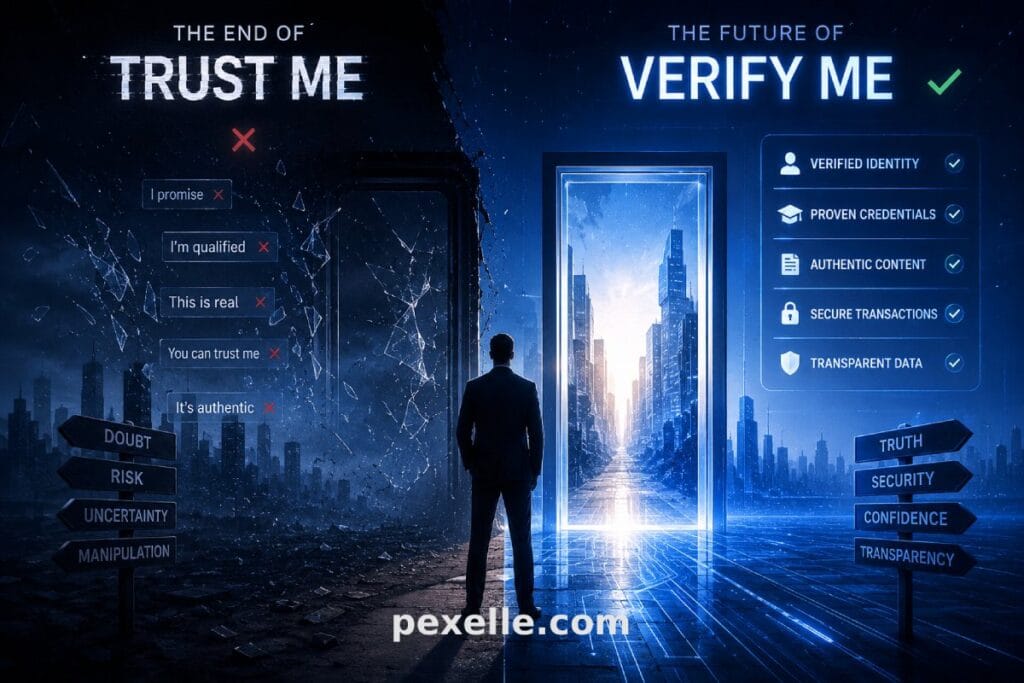
“Trust me.”
- A handshake.
- A recommendation.
- A diploma.
- A resume.
- A company logo.
- A government-issued document.
These symbols represented credibility because verifying them was difficult, expensive, or simply impossible.
But we are entering a new era where trust is no longer enough.
The future belongs to verification.
The Trust Crisis
Today’s digital world is experiencing an unprecedented trust problem.
Artificial intelligence can generate convincing text, realistic voices, fake videos, forged certificates, and even synthetic identities within minutes.
Anyone can claim:
- “I’m a certified engineer.”
- “I graduated from this university.”
- “This image is authentic.”
- “This transaction happened.”
- “This product is genuine.”
The problem is no longer creating believable information.
The problem is proving what is real.
As AI becomes more powerful, human judgment becomes less reliable.
Claims Are Cheap
In economics, scarcity creates value.
Claims have become abundant.
Verification remains scarce.
This changes everything.
A claim without evidence has almost zero informational value.
Soon, every digital interaction will trigger an automatic question:
Can you prove it?
Not because people are cynical.
Because technology has made deception inexpensive.
Trust Doesn’t Scale
Trust works remarkably well inside small communities.
Families trust each other.
Friends trust each other.
Small businesses build reputations over years.
But the internet connected billions of strangers.
The larger the network becomes, the weaker trust alone becomes.
Global commerce cannot rely on personal relationships.
Digital healthcare cannot depend on assumptions.
International hiring cannot depend on polished resumes.
Financial systems cannot depend on promises.
Scale requires verification.
The Shift from Reputation to Evidence
Historically, reputation acted as a proxy for truth.
Large companies were trusted because of their brand.
Universities because of their history.
Governments because of authority.
Experts because of credentials.
But reputation is becoming insufficient.
Modern users increasingly expect evidence.
Instead of:
“I worked here.”
People will ask:
Show the employment record.
Instead of:
“I earned this certification.”
They will ask:
Verify the credential.
Instead of:
“This photo is original.”
They will ask:
Show its provenance.
The burden is shifting from persuasion to proof.
AI Is Accelerating the Change
Ironically, artificial intelligence is both the problem and the solution.
AI dramatically lowers the cost of creating convincing misinformation.
Deepfakes.
Synthetic identities.
AI-generated documents.
Fabricated portfolios.
Automated scams.
At the same time, AI can also assist in analyzing evidence, detecting anomalies, tracing provenance, and validating authenticity.
The future is not AI versus humans.
It is AI-powered verification versus AI-powered deception.
Verification Becomes Infrastructure
Most people think of verification as an individual action.
Checking an ID.
Reviewing a certificate.
Calling a reference.
But verification is evolving into infrastructure.
Invisible.
Automatic.
Continuous.
Imagine a world where:
- Academic degrees are instantly verifiable.
- Professional licenses update automatically.
- Product origins are cryptographically proven.
- AI-generated content carries authenticated provenance.
- Employment history is verified without paperwork.
- Digital identities cannot be impersonated.
Users won’t need to manually investigate every claim.
Verification will happen behind the scenes.
Just as HTTPS quietly secures websites today.
Every Industry Will Change
This transformation extends far beyond cybersecurity.
Healthcare will verify medical credentials instantly.
Finance will verify transactions continuously.
Recruitment will validate experience instead of reading resumes.
Education will issue credentials that cannot be forged.
Insurance will verify events before processing claims.
Supply chains will authenticate every step of production.
Media organizations will verify content before publication.
Governments will modernize identity systems.
The verification layer will quietly support every digital interaction.
Trust Will Become Measurable
Today, trust is largely subjective.
“I think this source looks credible.”
“I believe this company.”
“I assume this document is authentic.”
Tomorrow, trust will become quantifiable.
Every claim may carry measurable evidence.
Authenticity scores.
Verification history.
Cryptographic signatures.
Independent attestations.
Source provenance.
Instead of opinions, systems will evaluate evidence.
Privacy and Verification Can Coexist
Many people mistakenly believe verification requires exposing more personal information.
The opposite is increasingly possible.
Modern cryptographic techniques allow people to prove specific facts without revealing unnecessary data.
Instead of sharing an entire identity, someone may simply prove:
- I am over 18.
- I hold a valid medical license.
- I completed this certification.
- I own this asset.
Verification does not have to mean surveillance.
It can mean selective, privacy-preserving proof.
The New Competitive Advantage
Organizations often compete on speed.
Price.
Features.
User experience.
Customer service.
Increasingly, another differentiator will emerge:
Verifiable trust.
The companies that can prove their claims, validate their data, authenticate their content, and demonstrate transparency will earn lasting confidence.
Not because they ask people to trust them.
Because they make trust unnecessary.
Beyond “Trust Me”
The internet’s first decades were built on connectivity.
The next decades will be built on credibility.
People will no longer ask:
“Who says this is true?”
They will ask:
“What evidence supports it?”
That subtle shift changes everything.
It transforms business, education, finance, healthcare, government, artificial intelligence, and every digital interaction.
The future does not eliminate trust.
It upgrades it.
Trust will no longer depend on reputation alone.
It will be earned through verifiable evidence.
And in that future, the most powerful statement will no longer be:
“Trust me.”
It will be:
Verify me.
Conclusion
History has repeatedly shown that every major technological leap demands a stronger foundation of trust. As the digital world grows more complex and AI blurs the line between reality and fabrication, trust based solely on reputation or promises will no longer be sufficient.
The next generation of digital systems will not ask users to believe. They will empower users to verify.
In the coming decade, the organizations, platforms, and individuals that embrace transparent, cryptographically verifiable, and privacy-preserving proof will become the new standard of credibility.
The era of Trust Me is ending.
The era of “Prove It has already begun.
Source : Medium.com