
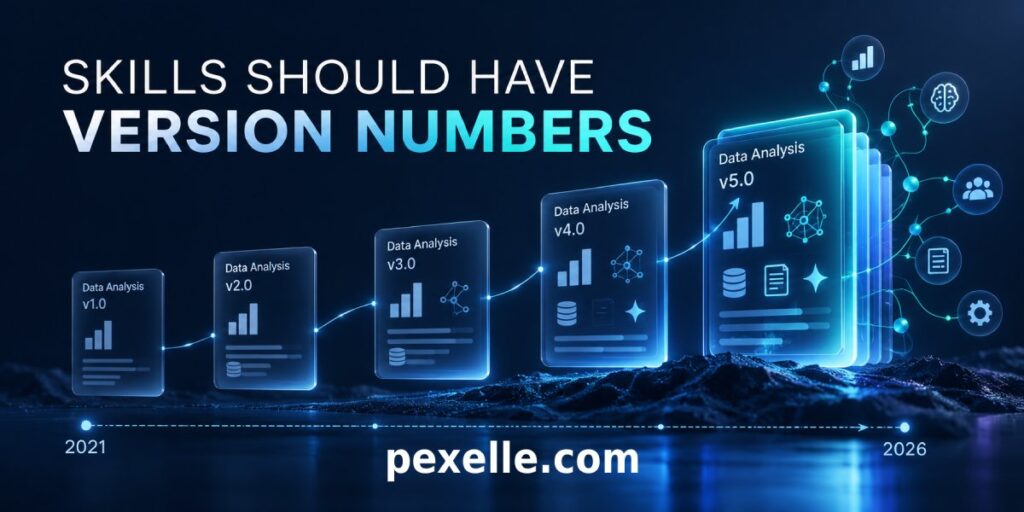
A skill is not a permanent label. It is a capability that changes with time.
Imagine two professionals who both list Python as a skill.
One learned Python in 2021 and has used the same scripts since. The other has spent the last five years building applications, working with modern libraries, reviewing AI-generated code, and solving new problems.
Their profiles may show the same word:
Python.
But does that word describe the same capability?
Not necessarily.
This is one of the biggest weaknesses in the way we represent professional skills today. We treat skills as static labels, even though the tools, practices, and expectations behind them continue to change.
Perhaps it is time to think about skills differently:
What if skills had version numbers?
The Problem With a Static Skill Profile
Most professional profiles represent skills as a list:
- Python
- Project Management
- Digital Marketing
- Cybersecurity
- Data Analysis
These labels are useful as a starting point. They tell us what someone has encountered or worked with.
But they leave important questions unanswered.
When did the person last use the skill? What kind of work did they do with it? Which tools or methods were involved? Can they still apply it in a relevant context today?
A person who used a technology five years ago may still have strong fundamentals. They may also need time to become familiar with newer tools. Both can be true.
Similarly, someone who started using a technology six months ago may be familiar with its latest features but have limited experience solving difficult problems.
A static label hides both stories.
Python v2021 Is Not the Same as Python v2026
Think about what “knowing Python” might mean for two different people.
In 2021, a developer might have used Python primarily to automate spreadsheets, clean datasets, or build simple web applications.
In 2026, another developer might use Python to build AI-powered systems, connect APIs, manage data pipelines, review AI-generated code, or deploy applications in cloud environments.
Both people know Python. But their experiences, contexts, and current capabilities may differ substantially.
This does not mean that Python knowledge from 2021 has expired. Many foundational concepts remain valuable: variables, functions, debugging, data structures, and clear thinking do not disappear when a new tool arrives.
The point is that the single label Python cannot explain which parts of the skill a person has maintained, expanded, or recently applied.
A versioned skill profile could tell a richer story:
Python
Foundation: Learned in 2021
Recent application: API integration and automation in 2026
Evidence: Completed projects and code reviews
Current focus: Reliable, maintainable AI-assisted development
That description is more useful than a badge that simply says “Python.”
A Version Number Is More Than a Date
The idea of skill versions is not just about adding a year next to a skill.
A year can show when something happened, but it cannot prove how well someone performs.
A person may have completed a course last month and still be a beginner. Another may have last used a tool two years ago but retain strong expertise.
A meaningful skill version would combine several dimensions:
- Foundation: What does the person understand?
- Application: What have they done with the skill?
- Context: In what environment did they use it?
- Recency: When was it last applied or assessed?
- Evidence: What supports the claim?
- Change: How has the capability developed over time?
Together, these dimensions could help turn a skill from a static keyword into a living record.
From Skill Claims to Skill History
Today, most profiles show what a person says they know. A versioned profile could show how that capability developed.
For example:
Project Management v1
The person coordinated tasks for a small internal team.
Project Management v2
They managed budgets, schedules, and external suppliers across multiple projects.
Project Management v3
They led complex projects involving distributed teams, changing requirements, and AI-assisted planning tools.
The version numbers here are not official qualifications. They are a way to describe meaningful changes in scope and evidence.
This approach makes progress visible. It also recognizes that a skill can deepen without a person changing job titles.
Someone can become significantly better at their work while remaining a project manager, designer, technician, or developer.
Their title may stay the same. Their capability does not.
Not Every Skill Changes at the Same Speed
Some skills evolve quickly. Others remain valuable for decades.
A framework, software tool, or platform may change significantly in a short period. Meanwhile, foundational abilities such as critical thinking, communication, problem-solving, and leadership can remain relevant across many environments.
But even durable skills can develop.
A person may communicate effectively in a small team, then learn to communicate across departments, cultures, or high-pressure situations. The underlying skill remains recognizable, while its application becomes broader.
That is why versioning should not imply that every older skill is obsolete.
Instead, it should help answer:
Which parts of this capability are enduring, and which parts depend on a changing context?
For a cybersecurity professional, understanding risk may remain fundamental. Familiarity with a specific platform, threat, or regulatory requirement may need more frequent review.
For a construction professional, practical judgment and craftsmanship remain essential. Materials, building methods, equipment, and standards can still change.
A useful profile should make both visible.
AI Is Changing What It Means to Use a Skill
Artificial intelligence adds another layer to this discussion.
Consider software development. A developer may now use AI to generate an initial implementation, explore alternatives, or explain unfamiliar code.
But producing code is only one part of the work.
The developer may still need to:
- Understand the problem.
- Evaluate the generated solution.
- Identify errors and security risks.
- Test behavior in real conditions.
- Maintain the system over time.
- Take responsibility for the result.
The skill has not disappeared. Its expression may be changing.
The same applies to writing, research, design, analysis, and many other fields. As AI tools become part of everyday work, skill profiles need to capture more than whether someone can produce an output.
They should also help show whether the person can direct, evaluate, improve, and take responsibility for that output.
A versioned skill record could reflect this shift without pretending that AI-assisted work is automatically better or worse than work completed without AI.
The key question is what the person contributed and what they can demonstrate.
Evidence Matters More Than the Version Label
A version number on its own could become another empty claim.
Anyone could write:
“Leadership v5”
“Python v2026”
“AI Strategy v3”
But what do those labels actually mean?
Without context or evidence, very little.
For skill versioning to be useful, each update should be connected to something meaningful. That evidence could include:
- A completed project.
- A practical assessment.
- A portfolio item.
- A verified contribution.
- Feedback from collaborators.
- A qualification or training record.
- A demonstration of work.
- An explanation of decisions made and problems solved.
Different forms of evidence have different strengths. A certificate can show that someone completed a course. A project can show applied work, although it may not reveal exactly what each person contributed. An assessment can demonstrate performance in a particular setting, but it may not capture every real-world challenge.
No single piece of evidence tells the whole story.
The goal is not to create a perfect score for every human ability. It is to provide enough context for someone else to make a better-informed judgment.
Skills Can Be Updated Without Erasing the Past
Software updates often replace earlier versions. Human development is more complicated.
When someone learns a new approach, they do not necessarily lose their previous knowledge. Their experience accumulates.
A professional who learned to design without AI and later learned to work with AI brings both perspectives. A technician who understands older equipment may be especially valuable when maintaining systems that are still in use.
A versioned skill profile should preserve that history.
Instead of saying:
“The old skill is outdated.”
It might say:
“This skill was demonstrated in this context, at this time, and later expanded in another context.”
That distinction matters. Older experience may be highly relevant, even when it needs to be complemented by recent evidence.
What Happens When a Skill Has Not Been Used Recently?
A versioned profile could also make skill recency easier to understand.
Someone might have been highly capable in a technology several years ago but moved into another role. Their knowledge has not necessarily disappeared, but it may no longer reflect current tools or practices.
Rather than marking the skill as simply “expired,” a profile could show:
- Last demonstrated: 2022
- Previous context: Production application development
- Current status: Not recently assessed
- Potential next step: Refresh or demonstrate current application
This is more honest than treating every skill as permanently current.
It is also fairer than assuming that an older skill has no value.
A Better Way to Hire
For employers, skill versioning could lead to more precise conversations.
Instead of asking:
“Do you know Python?”
A hiring manager could ask:
“What have you built with Python recently, and in what environment?”
Instead of asking:
“Do you have leadership experience?”
They could ask:
“What kind of teams have you led, through which challenges, and what did you learn?”
These questions make it easier to distinguish between familiarity, practical experience, and demonstrated capability.
They may also reveal talent hidden by traditional hiring signals. Someone without the expected job title might have developed a relevant skill through an internal project, community work, or a different industry.
At the same time, employers should avoid treating recency as the only measure of value. A candidate with older experience may be able to refresh their knowledge quickly, and a candidate with recent exposure may still need substantial support.
Good hiring requires judgment, not just a newer version number.
A Better Way to Plan Careers
For individuals, a versioned approach could make professional growth easier to see.
Many people struggle to answer:
“How have my skills changed over the last few years?”
They may remember their job titles, but not the smaller steps that made them more capable: a difficult project, a new responsibility, a problem they solved, or a technique they learned from a colleague.
A skill history could help people reflect on questions such as:
- What can I do now that I could not do a year ago?
- Which skills have I applied recently?
- Where have I gained depth?
- Which capabilities do I want to refresh?
- What evidence could help others understand my work?
This can be especially valuable during career transitions. A person moving into a new field may already have relevant capabilities, even if their previous titles do not make that obvious.
A Better Way for Organizations to Understand Capability
Organizations also tend to view skills as a snapshot.
They might run a skills survey, create a spreadsheet, and discover six months later that the information is already incomplete.
People learn. Projects change. New tools are introduced. Responsibilities move between teams.
A living skill record could help an organization understand:
- Which capabilities exist across its workforce.
- Where people have relevant recent experience.
- Which skills are developing.
- Where knowledge depends on only a few people.
- Which teams may need training or support.
- Who could contribute to a new opportunity.
However, this kind of system needs to be designed carefully.
If employees believe that every outdated entry will be used against them, they may avoid being honest. If version numbers become simplistic rankings, people may focus on appearing current instead of actually learning.
The purpose should be to support development and better decisions, not to create another surveillance system.
Who Decides When a Skill Gets a New Version?
This may be the most difficult question.
A software company can define what changes between version 1 and version 2 of a product. Human skills do not have one universal owner.
Who decides whether someone’s leadership has moved to a new level? The individual? Their manager? A client? An independent assessor?
The answer may depend on the skill and the purpose of the assessment.
A practical system could distinguish between different kinds of updates:
- Self-reported: The person describes new experience or learning.
- Peer-supported: A colleague confirms a contribution or provides feedback.
- Assessed: The person demonstrates capability through a defined assessment.
- Credentialed: An institution or professional body verifies a qualification.
- Evidence-backed: The person shares work that others can inspect.
These labels should not automatically be treated as equal. They show where the information came from, allowing others to judge its relevance and reliability.
Transparency is more useful than pretending every skill can be measured in exactly the same way.
The Risks of Versioning Human Capability
The idea is promising, but it could also be misused.
False precision
A label such as “Leadership v4.2” may look scientific without explaining what changed or how it was assessed.
Bias toward recent activity
People who take parental leave, change careers, face illness, or have fewer opportunities should not automatically be treated as less capable.
Endless pressure to update
Not every professional needs to prove a new version of every skill every year. Some abilities remain useful for a long time.
Unequal access to evidence
Not everyone can share their best work publicly. Client confidentiality, security requirements, and employer policies can restrict what a person is allowed to disclose.
Confusing activity with ability
Using a tool frequently does not automatically mean using it well. Similarly, a recent course does not necessarily prove practical capability.
A responsible approach should make room for context, privacy, and different ways to demonstrate expertise.
The goal is better understanding, not perfect measurement.
What a Living Skill Profile Could Look Like
Imagine a professional profile that does more than list skills.
For each capability, it could show:
| Element | What it helps explain |
|---|---|
| Skill | The capability being described |
| Foundation | Core knowledge or training |
| Applications | The work or situations where it has been used |
| Evidence | Projects, assessments, feedback, or credentials |
| Last demonstrated | When relevant evidence was recorded |
| Development history | How the capability has changed |
| Current focus | What the person is learning or practicing next |
For example:
Skill: Data Analysis
Foundation: Data cleaning, visualization, and statistical reasoning
Application: Operational reporting and business decision support
Evidence: A completed dashboard project and stakeholder feedback
Last demonstrated: 2026
Development: Expanded from spreadsheet reporting to automated data pipelines
Current focus: Evaluating AI-assisted analysis and communicating uncertainty
This profile does not claim to capture everything the person knows. It gives someone a better starting point for a meaningful conversation.
What This Means for Pexelle
At Pexelle, we believe professional capability deserves to be understood with more context than a title or a list of keywords can provide.
A person’s skills are shaped by learning, practice, decisions, and real work. They can grow in depth, move into new environments, and become relevant in unexpected ways.
Thinking about skills as versions opens an interesting possibility: a professional profile that evolves with the person behind it.
Not a profile that says, “This person learned something once.”
A profile that helps answer:
What can this person do, where have they demonstrated it, and how is that capability developing?
That requires evidence, context, and room for human judgment.
The Future of Skills Is Not Static
The world does not stand still, and neither do people.
A skill learned in 2021 may still be valuable in 2026. It may also have expanded, changed direction, or need refreshing. A single word on a profile cannot tell us which.
Version numbers are a useful metaphor because they remind us that capability has a history and a future.
The next generation of professional profiles should make that journey visible.
Because a skill is not just something you have.
It is something you build, apply, and continue to develop.
Source : Medium.com