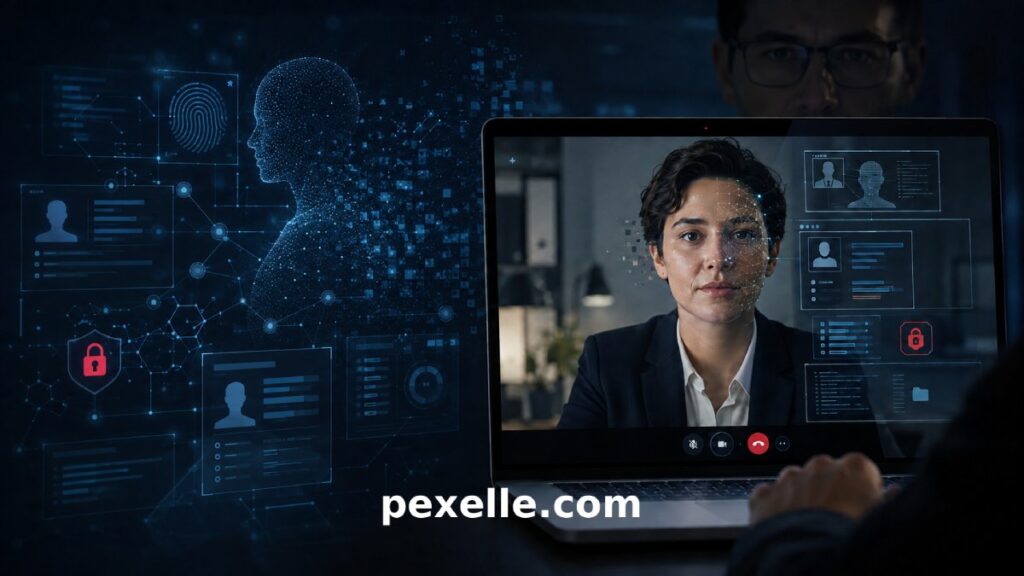
When a candidate can manufacture a face, a voice, a career history, and even a live interview, hiring becomes a security boundary
For decades, recruitment has operated on a quiet assumption: the person behind the application is real.
A CV might exaggerate. A portfolio might borrow too heavily from someone else’s work. A candidate might rehearse answers or overstate a previous role. But underneath those familiar forms of dishonesty, employers could usually assume that the name, face, voice, work history, and person in the interview belonged to one human being.
That assumption is no longer safe.
Generative AI can now help create professional photographs, rewrite employment histories, generate tailored cover letters, translate conversations in real time, alter voices, and manipulate live video. Stolen identity documents can be combined with fabricated profiles, shell-company websites, remote access infrastructure, and local intermediaries. The result is not simply a dishonest applicant. It is a synthetic professional identity designed to survive the recruitment process and acquire legitimate access to an organization.
This is why the deepfake employee should not be treated as a strange future scenario. The core threat already exists, even when every case does not rely on a Hollywood-quality face swap.
In June 2025, the US Department of Justice announced coordinated action against schemes in which overseas workers allegedly used stolen and false identities to obtain remote IT jobs. According to the department, the operations affected more than 100 US companies and involved laptop farms, fraudulent websites, financial accounts, and local facilitators. Once hired, some workers gained access to sensitive company information, source code, export-controlled technology, and virtual assets. The Justice Department also described a separate alleged theft of more than $900,000 in cryptocurrency. US Department of Justice
Google Threat Intelligence has separately reported that North Korean IT workers have experimented with AI-generated profile photographs, deepfakes in video interviews, and AI writing tools that can reduce language barriers. Google Threat Intelligence
The lesson is not that every remote candidate is suspicious. Nor is it that deepfake technology has made human verification impossible. The lesson is more precise: recruitment has become part of the cybersecurity perimeter, and identity can no longer be accepted as a one-time visual impression.
A CV Is a Claim, Not Proof
A traditional CV packages several claims into a familiar format:
- This is my name.
- This is where I worked.
- These are the projects I completed.
- These are the skills I possess.
- These people and institutions can confirm my history.
Recruiters often assess whether the story appears coherent. Dates are checked for obvious gaps. Job titles are compared with responsibilities. LinkedIn profiles, portfolios, references, and interview answers are used to reinforce the narrative.
But generative AI dramatically lowers the cost of coherence.
A fabricated applicant no longer needs to write a convincing career story alone. AI can align the CV with the job description, generate plausible project explanations, anticipate interview questions, remove linguistic inconsistencies, and create several versions of the same professional persona for different platforms. A fake profile can be made to look active and complete. A shell business can provide an apparent employment history. A collaborator can answer reference requests. Stolen personal information can add real-world details to a false application.
This creates a critical distinction between plausibility and verification.
A plausible identity is one whose components seem to fit together. A verified identity is one whose important claims have been independently connected to authoritative evidence.
Most recruitment systems are still better at measuring the first than establishing the second.
The Video Call Has Lost Its Special Status
When employers became concerned about fake profiles, the video interview became an informal proof-of-person test. Seeing a candidate’s face, hearing spontaneous answers, and observing natural behaviour felt more trustworthy than reading documents.
But a video call proves less than many organisations assume.
Synthetic video can modify a face. Voice conversion can change how a person sounds. AI assistance can generate answers or translate them during the conversation. A different person can attend the interview on behalf of the worker who later receives system access. Even without sophisticated deepfake software, camera quality, compression, virtual backgrounds, poor lighting, and unstable connections can hide inconsistencies.
The FBI has warned that facilitators have attended virtual interviews and meetings on behalf of fraudulent remote workers. Its guidance advises employers to scrutinise identity documents, verify education and employment directly, and use more interactive on-camera checks when in-person verification is unavailable. FBI guidance
Yet the answer cannot be a collection of internet tricks. Asking someone to turn their head, move a hand across their face, or change lighting may expose a weak manipulation system, but such tests will age quickly. High-quality media generation is improving, and legitimate candidates can also fail improvised tests because of disability, anxiety, bandwidth, camera hardware, or cultural and language differences.
A video interview should therefore be treated as one signal among several, not as conclusive evidence of identity.
This Is Not Just Recruitment Fraud
Calling the problem “candidate fraud” makes it sound like an HR issue that ends when an application is rejected. That framing understates the risk.
Hiring is one of the few business processes designed to transform an external stranger into a trusted insider. A successful candidate may receive:
- A company laptop
- Corporate email and messaging accounts
- Access to source code and development environments
- Customer or employee data
- Cloud infrastructure and internal documentation
- Payment systems or financial information
- Credentials, API keys, and production access
- Knowledge of organisational processes and security weaknesses
Once the false identity passes recruitment, the attacker may no longer need to defeat the perimeter. The company provisions access on the attacker’s behalf.
This turns synthetic identity into an insider-risk mechanism.
The potential objectives vary. Some fraudulent workers may seek salaries under a false identity. Others may gather intelligence, steal intellectual property, divert funds, place malicious code, establish persistent access, or extort the employer after collecting sensitive data. In the 2025 Justice Department cases, alleged operators used local laptop farms so company devices appeared to be in the expected country while overseas workers accessed them remotely. Authorities said some workers obtained sensitive employer data and source code, including controlled technical information. US Department of Justice
The attack is powerful because every individual component may appear ordinary. A remote interview is ordinary. Shipping a laptop is ordinary. A contractor working from home is ordinary. A new employee requesting access is ordinary. The danger emerges from the chain.
The Synthetic Professional Is a System, Not a Face
The phrase “deepfake employee” may suggest that the central problem is a digitally altered face. In reality, a durable synthetic professional identity can involve several coordinated layers:
1. Identity layer
Stolen or fabricated names, identity documents, addresses, tax details, and payment accounts create the legal appearance of a person.
2. Reputation layer
A CV, professional profile, portfolio, code repository, references, and shell-company website create the appearance of career continuity.
3. Interaction layer
AI writing, voice conversion, translation, coaching, deepfake video, or a stand-in interviewer helps the persona perform in real time.
4. Location layer
VPNs, proxies, residential connections, device forwarding, and laptop farms create the appearance that the worker is operating from an approved location.
5. Work layer
The individual doing the interview may not be the person completing the work. Tasks can be shared among several operators or completed with extensive AI assistance while one identity remains visible to the employer.
6. Access layer
Once hired, legitimate corporate credentials convert the fabricated identity into an authorised presence inside the organisation.
This is why face detection alone cannot solve the problem. An employer can correctly determine that a video contains no detectable manipulation and still hire the wrong person. The face might be real while the name is stolen. The interviewee might be genuine while another operator later controls the laptop. The employee might begin legitimately and later transfer credentials or access.
The organisation must verify the relationship among identity, location, capability, device, and ongoing behaviour.
Why Deepfake Detectors Are Not Enough
Automated detection has a role, particularly at scale, but it should not become a new single point of trust.
Deepfake detectors face an adversarial problem. Generation methods evolve. Video is compressed by conferencing platforms. Lighting, camera quality, skin tone, disability, makeup, background effects, and network conditions can influence results. A detector may identify an artefact without proving malicious intent, or miss a new technique entirely.
More importantly, detection asks a narrow question: “Was this media manipulated?”
The organisation needs answers to broader questions:
- Is this the person named in the application?
- Does this person control the documents and accounts being presented?
- Did this person actually perform the claimed past work?
- Is the person interviewed the person who will perform the job?
- Is the worker operating from an authorised location and device?
- Does their behaviour remain consistent after access is granted?
No single biometric check, background report, reference, or AI detector can answer all of these.
Recruitment Needs Defence in Depth
Cybersecurity matured when organisations stopped trusting a single firewall. Hiring now requires the same shift. The goal is not to create a hostile or invasive process. It is to make high-impact claims independently verifiable while keeping controls proportionate to the role.
Verify identity through independent channels
Identity evidence should be checked through trusted processes appropriate to the country, role, and applicable privacy and employment law. Important details should not be validated only against other materials supplied by the candidate. Organizations should also minimize data collection and protect any sensitive documents they retain.
For high-risk remote roles, a live or in-person identity check may be justified. Where in-person checks are impractical, organisations can use a reputable identity verification process with explicit consent, documented retention rules, and human review for disputed results.
Verify history at the source
Previous employment and education should be confirmed using independently obtained contact details, not only the phone number or email listed by the applicant. Recruiters should be cautious when several references share unusual domains, recently created web presences, or contact patterns that cannot be corroborated.
This does not mean rejecting candidates from small companies, emerging markets, or non-traditional careers. It means recording what was verified, what could not be verified, and how uncertainty affects access decisions.
Test capability through live, role-relevant work
A polished portfolio is useful, but it is no longer enough to establish authorship or competence. Candidates can be asked to reason through a realistic problem, explain trade-offs, review flawed work, or modify an earlier solution. The objective should not be surveillance or puzzle performance. It should be evidence that the candidate understands the decisions their claimed experience would require.
Organizations should also define an AI-use policy for assessments. If AI is allowed, candidates can be evaluated on how they direct it, verify its output, identify errors, and take responsibility for the final decision. Concealing AI use and using AI competently are not the same thing.
Bind interview, onboarding, and employment
Verification should not end with the offer letter. The identity confirmed during onboarding should be connected to the person who receives the device, activates accounts, completes early meetings, and performs the work.
Unexpected changes in shipping address, payment destination, phone number, device location, or work pattern should trigger proportionate review. They should not produce automatic accusations. Legitimate workers move, travel, replace devices, and experience connectivity problems. The purpose is to resolve inconsistency, not punish normal variation.
Assume every new hire is initially low trust
Least privilege is not a judgment about character. It is a safe default.
New employees and contractors should receive only the access required for their current responsibilities. Privileges can expand as identity, behaviour, and business need become established. Sensitive actions can require stronger authentication, peer approval, secure devices, and auditable workflows.
This limits harm from both malicious insiders and ordinary mistakes.
Monitor actions, not personalities
Security monitoring should focus on risk-relevant behaviour such as unusual remote access, unauthorised tools, mass downloads, credential sharing, unexpected geographic patterns, or attempts to bypass device controls. It should be transparent, lawful, and designed with privacy in mind.
Accent, appearance, nationality, imperfect language, nervousness, or a weak internet connection are not reliable indicators of fraud. A defensible process evaluates evidence and behaviour, not stereotypes.
Prepare an incident path before it is needed
If a synthetic or stolen identity is suspected, HR, security, legal, privacy, payroll, and management may all need to act. The company should know how to preserve evidence, restrict access safely, review data exposure, contact affected identity-theft victims, meet reporting duties, and involve relevant authorities.
Improvised confrontation can destroy evidence or create legal and employee-relations risks. A documented response process is safer for both the organisation and legitimate employees who may have been incorrectly flagged.
Trust Must Continue After the Interview
The larger change is philosophical.
Companies have traditionally treated trust as a decision made at the hiring gate. The applicant is outside. The employee is inside. Background checks and interviews support a binary transition from unknown to trusted.
Synthetic identity breaks that model.
Trust should instead be understood as a maintained relationship among verified claims:
- The person is who they claim to be.
- Their relevant credentials and history are authentic.
- Their demonstrated capability matches the role.
- The authorised person controls the authorised device and account.
- Their access remains appropriate to current responsibilities.
- Significant actions can be attributed and reviewed.
These claims do not all need to be checked continuously or invasively. But they should not be collapsed into a single moment of visual confidence during a video call.
The future of hiring will require something closer to continuous, evidence-based trust. That means combining identity assurance, contribution verification, device security, access governance, and accountable work records.
The Human Cost of Getting This Wrong
Poorly designed verification can cause its own harm.
An organisation frightened by deepfakes may impose intrusive biometric collection, discriminate against international applicants, reject candidates with accessibility needs, or treat ordinary technical problems as guilt. It may store identity documents insecurely or rely on opaque scoring systems that candidates cannot challenge.
That would replace one trust failure with another.
Effective verification should follow several principles:
- Proportionality: stronger checks for roles with greater access or impact.
- Transparency: candidates know what is checked and why.
- Data minimisation: collect and retain only what is necessary.
- Accessibility: provide reasonable alternative verification methods.
- Human review: do not let an automated flag make the final decision alone.
- Appealability: legitimate candidates can correct errors and explain anomalies.
- Consistency: apply controls by role and risk, not by subjective suspicion.
The objective is not to prove that every candidate is dangerous. It is to create a process in which important claims can be trusted without forcing people to surrender unnecessary privacy or dignity.
From “Trust Me” to “Here Is the Evidence”
The deepfake employee exposes a weakness that existed before generative AI: professional identity has always depended heavily on self-asserted claims and fragmented signals.
AI did not invent CV fraud, proxy interviews, identity theft, fake references, or insider threats. It made them cheaper to combine, easier to scale, and harder to recognize through intuition alone.
This changes what a credible professional identity must provide.
The next generation of hiring systems cannot rely only on a profile that looks complete. It must help establish which institution issued a credential, which organisation confirms a role, which person produced a contribution, which evidence supports a capability, and whether the same verified person remains connected to the work.
That does not require putting every private detail on a public ledger or creating a universal score for human beings. It requires a better evidence layer: selective, consent-based, auditable, privacy-aware, and difficult to transfer from one person to another.
This is where platforms such as Pexelle can help shape a more trustworthy professional ecosystem. The opportunity is not to build another social profile filled with claims. It is to create infrastructure that connects identity, capability, contribution, and attestation while allowing individuals to control how evidence is shared.
Conclusion
The deepfake employee is already here, not because every fraudulent worker uses a perfect synthetic face, but because the complete professional persona can now be manufactured as a coordinated system.
A convincing CV can be generated. A profile can be fabricated. A video interview can be manipulated or delegated. A laptop can appear to be in one country while being controlled from another. And once the candidate is hired, ordinary onboarding can provide legitimate credentials to an unverified operator.
The appropriate response is neither panic nor blanket distrust of remote work. It is a more mature trust architecture.
Recruitment teams must verify claims independently. Security teams must treat hiring as part of the access lifecycle. Managers must evaluate demonstrated reasoning, not merely polished output. Organizations must use least privilege, behavioural safeguards, and clear incident procedures. Candidates must be given transparent, fair, and privacy-respecting ways to prove who they are and what they can do.
In the age of synthetic identity, seeing is no longer believing.
Trust must be supported by evidence.
Source : Medium.com