The Next Layer of Digital Trust Is Not Proving Who You Are, but Proving What You Can Actually Do
For decades, digital systems have been trying to answer one fundamental question:
Who are you?
Passwords tried to answer it.
Email verification improved it.
Multi-factor authentication strengthened it.
Biometrics made it harder to fake.
Government-issued identity verification connected digital accounts to real people.
Today, increasingly sophisticated identity systems can verify that a person behind an account is a real individual and that their identity matches trusted evidence. NIST describes identity proofing as establishing confidence that an applicant is who they claim to be.
That is enormously important.
But it solves only one part of the trust problem.
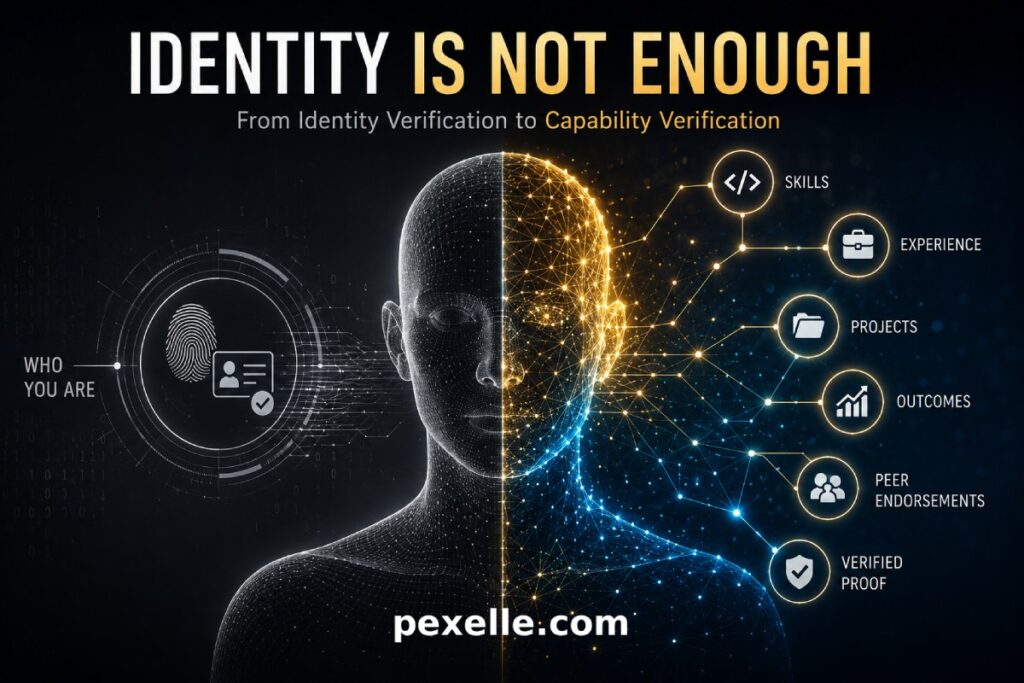
Knowing who someone is tells us surprisingly little about what that person can actually do.
- A verified identity does not prove that someone can write production-grade software.
- A verified engineer is not necessarily capable of designing a safe bridge.
- A verified designer is not necessarily an excellent designer.
- A verified consultant is not necessarily experienced in the industry they claim to understand.
- A verified professional profile does not automatically make every skill listed on that profile true.
This creates a major gap in the architecture of digital trust.
We have spent years building infrastructure for Identity Verification.
The next challenge may be building infrastructure for Capability Verification.
1. Identity and Capability Are Two Different Questions
Identity verification answers:
Are you really the person you claim to be?
Capability verification asks:
Can you actually do what you claim you can do?
These questions are related, but fundamentally different.
Imagine two people:
Person A
Identity: Verified
Name: Verified
Email: Verified
Employment history: Partially verified
Claimed skill: Senior Python Developer
Person B
Identity: Verified
Name: Verified
Email: Verified
Employment history: Partially verified
Claimed skill: Senior Python Developer
From an identity perspective, both individuals may be equally trustworthy.
But professionally, their capabilities could be completely different.
Person A may have spent ten years designing distributed systems serving millions of users.
Person B may have completed several Python courses and built a few small projects.
Both are real people.
Both may legitimately describe themselves as developers.
But their capability evidence is dramatically different.
This distinction becomes increasingly important as economic activity moves online.
The internet needs more than:
Verified Human
It increasingly needs:
Verified Human + Verified Capability
2. The Internet Has Become Good at Verifying Accounts
Modern digital identity infrastructure is becoming sophisticated.
Systems can verify:
- government-issued documents
- phone numbers
- email addresses
- biometric characteristics
- device ownership
- organizational membership
- account control
- age or eligibility
- cryptographic credentials
Standards are also evolving. The W3C Verifiable Credentials Data Model 2.0, published as a W3C Recommendation in 2025, provides a standardized model for tamper-evident digital credentials whose authorship can be cryptographically verified.
This represents major progress.
But identity infrastructure primarily establishes something about the subject.
It does not automatically establish the truth of every professional claim made by that subject.
Consider a verified profile containing:
Identity Verified ✓
Python
Cybersecurity
Machine Learning
Cloud Architecture
Project Management
Leadership
The checkmark may tell us:
This profile belongs to a verified individual.
It does not necessarily tell us:
This individual has demonstrated each of these capabilities at the claimed level.
That second problem requires a different trust architecture.
3. What Is Capability Verification?
Capability Verification can be defined as:
The process of establishing trustworthy evidence that a person possesses, has demonstrated, or has successfully applied a specific skill, competency, or ability.
The important word is:
evidence.
Capability verification should not simply replace one self-declared profile field with another digital badge.
The objective is to connect a capability claim to evidence strong enough for another party to evaluate it.
Instead of:
“I know Python.”
A capability system might establish:
Python Backend Development
Level: Advanced
Evidence: 14 verified projects
Professional usage: 4.2 years
Verified by: 3 organizations
Recent activity: 4 months ago
Assessment: Passed
Production systems: 6
Evidence confidence: High
The claim becomes much richer.
It moves from:
Declaration
to:
Evidence-backed claim.
4. Capability Verification Is Already Beginning to Emerge
Pieces of this infrastructure already exist.
For example, 1EdTech’s Open Badges standard allows credentials to represent skills, competencies, degrees, microcredentials, and other achievements. These credentials can include information about the issuer, criteria required for the achievement, and evidence demonstrating relevant skills. Open Badges 3.0 credentials are digitally signed and compatible with the W3C Verifiable Credentials model.
Similarly, the Comprehensive Learner Record standard supports verifiable records covering courses, competencies, skills, workplace achievements, and milestones.
These developments are important because they demonstrate a broader transition:
Digital credentials are expanding from identity toward achievements and capabilities.
But a truly universal capability layer would need to go further.
It would need to represent not only education or certificates, but evidence generated through actual work.
5. Certificates Are Not the Same as Capabilities
A common mistake would be to define capability verification simply as certificate verification.
They are not the same.
A certificate can prove:
Someone completed a course.
A professional certification may provide stronger evidence:
Someone passed an assessment defined by a recognized organization.
But capability often requires answering something more difficult:
Has this person successfully demonstrated this skill in a meaningful context?
Consider software engineering.
A university degree can be useful evidence.
A cloud certification can be useful evidence.
A coding assessment can be useful evidence.
But so can:
- successfully shipped software
- code contributions
- architectural decisions
- verified project participation
- production deployments
- peer attestations
- customer outcomes
- security audits
- bug-resolution history
- long-term professional usage
Capability is rarely represented perfectly by a single credential.
It is often better understood as an evidence graph.
6. From Skill Lists to Evidence Graphs
Professional profiles today are usually flat.
A profile might contain:
Skills
Python
AWS
Kubernetes
PostgreSQL
Docker
Machine Learning
But imagine a capability graph instead.
Python
Connected evidence:
- 23 verified projects
- 5 years of usage
- 4 employer attestations
- 312 verified contributions
- 2 technical assessments
- 6 production systems
Kubernetes
Connected evidence:
- 8 production deployments
- 3 infrastructure projects
- 2 employer attestations
- certification
- recent activity within 6 months
Machine Learning
Connected evidence:
- 3 production models
- 2 research projects
- 1 academic credential
- 4 peer endorsements
Now the system is not simply storing skills.
It is storing relationships between:
Person → Capability → Evidence → Attestor → Context → Outcome
This is far more useful than a conventional résumé.
7. Not All Evidence Should Be Equal
A serious capability verification system cannot treat every proof equally.
Consider five claims that someone knows cybersecurity.
- One is self-declared.
- One is endorsed by a friend.
- One comes from completing an online course.
- One comes from passing an independent technical assessment.
- One comes from five years of verified cybersecurity work at recognized organizations.
These pieces of evidence have different strengths.
Capability verification therefore requires something identity systems generally do not need at the same level:
Evidence weighting.
A system might evaluate evidence based on factors such as:
Source credibility
Who issued or verified the evidence?
Directness
Does the evidence directly demonstrate the skill?
Difficulty
How difficult was the task or assessment?
Recency
When was the capability last demonstrated?
Duration
Was the skill demonstrated once or continuously?
Context
Was the capability demonstrated in training, simulation, freelance work, research, or production?
Independence
Was the evidence independently verified?
Outcome
What happened as a result of the work?
Capability is not binary.
Evidence should not be either.
8. Capability Is Dynamic
Identity tends to be relatively stable.
Your professional capabilities are not.
You can learn a skill.
Improve it.
Stop using it.
Become an expert.
Lose familiarity.
Move into another field.
Capability verification therefore needs a concept that traditional credentials often struggle with:
time.
Imagine someone who was an expert in a framework in 2018 but has not used it since.
Should the system represent that person exactly the same as someone using the technology every day in 2026?
Probably not.
Capability systems may eventually need to model:
Capability strength over time.
For example:
Kubernetes
2019: Beginner
2020: Intermediate
2021: Advanced
2022: Advanced
2023: Advanced
2024: Limited activity
2025: Limited activity
2026: Recently demonstrated
Professional capability could become something that evolves continuously rather than a static label permanently attached to a profile.
9. AI Makes Capability Verification More Important
Generative AI dramatically reduces the cost of producing professional-looking information.
AI can generate:
- résumés
- cover letters
- portfolio descriptions
- project summaries
- technical explanations
- professional profiles
- case studies
- code samples
- certificates of completion
- interview preparation
- polished personal branding
This does not mean these materials are useless.
It means appearance is becoming cheaper.
Someone can increasingly look highly capable online without producing proportional evidence of capability.
The difference between:
looking capable
and
being demonstrably capable
therefore becomes economically important.
In an AI-rich economy, credibility may increasingly depend on evidence that is difficult to manufacture retrospectively.
- Verified work history.
- Verified outcomes.
- Verified contributions.
- Verified assessments.
- Verified attestations.
- Verified achievements.
The more synthetic information the internet produces, the more valuable trustworthy evidence may become.
10. AI Agents Will Need Capability Data
There is another reason this infrastructure matters.
Future economic decisions will increasingly be made or assisted by AI agents.
Imagine telling an AI system:
Find me a cybersecurity engineer capable of auditing a cloud infrastructure environment.
Today the AI may search:
résumés,
profiles,
keywords,
recommendations,
employment history,
ratings.
But imagine if it could query structured capability evidence instead.
It could ask:
Identity verified?
Yes.
Cloud security capability verified?
Yes.
AWS security experience?
37 verified evidence items.
Last demonstrated?
Two months ago.
Independent assessments?
Three.
Relevant production projects?
Eleven.
Evidence confidence?
High.
Now AI is no longer matching people primarily through keywords.
It is matching:
requirements to verified capabilities.
That could fundamentally change recruiting, freelancing, professional marketplaces, education, and workforce management.
11. Capability Verification Could Change Hiring
Traditional hiring often works like this:
Résumé → Screening → Interview → References → Assessment → Decision
Much of this process exists because employers lack trusted information.
The résumé makes claims.
The employer then spends time verifying those claims.
Capability infrastructure could move verification earlier.
Imagine:
Capability Profile → Machine Verification → Evidence Analysis → Interview → Decision
Instead of spending an interview determining whether someone actually knows Kubernetes, an employer could already have strong evidence of that capability.
The interview could focus on:
- judgment
- communication
- creativity
- strategic thinking
- culture
- problem solving
- role-specific challenges
Hiring becomes less about discovering whether claims are true and more about evaluating whether the person is right for the opportunity.
12. Capability Verification Could Change Education
Education could also become more outcome-oriented.
Instead of the primary professional signal being:
Degree: Computer Science
a person might possess hundreds of granular capability credentials accumulated across their lifetime.
For example:
Database Design
Verified by university assessment.
Python Development
Verified through employment.
Cloud Architecture
Verified through professional certification and projects.
Technical Leadership
Verified by employers and teams.
Machine Learning Deployment
Verified through production systems.
Education would not disappear.
Degrees would remain valuable.
But they could become one source of evidence inside a much larger capability graph.
This aligns with emerging digital credential standards that already support skills, competencies, achievements, and employment-related records.
13. Capability Verification Must Not Become a Universal Human Score
There is also an important danger.
Once capability data becomes structured, there will be temptation to compress everything into a single number:
Capability Score: 87
That would be convenient.
It could also be misleading and potentially harmful.
Human capability is multidimensional.
- A brilliant engineer may be a poor manager.
- An exceptional designer may have little leadership experience.
- A junior developer may have extraordinary capability in one narrow technical domain.
- A professional who lacks conventional credentials may possess years of highly valuable practical experience.
Capability verification should therefore avoid becoming:
a universal ranking of human value.
Instead, it should answer contextual questions.
Not:
How good is this person?
But:
What evidence supports this person’s capability to perform this specific type of work?
That distinction is critical.
14. Privacy Must Be Built Into Capability Infrastructure
Capability data could become extremely sensitive.
A complete professional evidence graph might reveal:
- employers
- projects
- clients
- work history
- performance
- professional relationships
- assessments
- failures
- locations
- dates
- certifications
- organizational affiliations
A capability verification system therefore cannot simply create a public database containing everything a person has ever done.
Individuals need control over what they disclose.
The W3C Verifiable Credentials architecture explicitly considers privacy and supports models where holders present credentials to verifiers rather than requiring every credential to live in one central public database.
Future capability infrastructure could extend this principle.
A person applying for a cloud engineering position might prove:
5+ years relevant experience
without exposing every employer.
They might prove:
AWS capability independently verified
without exposing confidential projects.
They might prove:
completed more than 10 production deployments
without revealing customer identities.
The strongest capability infrastructure may therefore combine:
verification + user control + selective disclosure.
15. The Architecture of Capability Verification
A mature capability ecosystem could contain several layers.
Layer 1: Identity
Establish that the subject is a real and correctly identified person.
Who are you?
Layer 2: Claims
The person or another entity makes claims about capabilities.
What do you claim you can do?
Layer 3: Evidence
Supporting information is attached.
What supports that claim?
Layer 4: Attestation
Trusted entities confirm particular evidence or capabilities.
Who confirms it?
Layer 5: Verification
Cryptographic and procedural mechanisms establish that credentials and evidence have not been improperly altered and originate from the stated issuer.
Is the evidence authentic?
Layer 6: Evaluation
A verifier determines whether the evidence is sufficient for a particular context.
Does this evidence satisfy my requirements?
This last distinction matters.
The W3C itself distinguishes verification from validation: cryptographic verification can establish properties such as authenticity and integrity, while deciding whether claims satisfy a verifier’s business requirements is a separate process.
Capability systems need both.
16. The Capability Passport
Eventually, professional profiles may evolve into something closer to a:
Capability Passport
A portable, user-controlled collection of verified professional capabilities.
Instead of rebuilding credibility every time someone joins a new platform, evidence could travel with them.
A developer could move from:
University
→ Employer
→ Freelance platform
→ Startup
→ Consulting network
→ AI talent marketplace
while retaining portable evidence accumulated across those environments.
The person would not need to start their reputation from zero each time.
Their professional history could become:
portable
verifiable
machine-readable
permissioned
interoperable
and potentially privacy-preserving.
Existing standards such as Open Badges already demonstrate how achievements can be represented as portable verifiable credentials, including criteria and supporting evidence.
A broader capability passport would extend this idea from credentials into a lifelong professional evidence network.
17. From Résumés to Proof
The résumé has survived for centuries because it is simple.
It compresses a person’s professional history into a document.
But its fundamental architecture is based on self-declaration.
The candidate writes:
I worked here.
I built this.
I know this.
I achieved this.
The employer decides what to believe.
Capability verification proposes a different architecture.
Instead of:
Claim → Trust
we move toward:
Claim → Evidence → Verification → Trust
The résumé may not disappear.
But it may eventually become an interface sitting on top of something much deeper:
a verifiable professional evidence layer.
18. Identity Verification Was the First Layer
The digital economy needed identity verification because online systems needed to know who was participating.
But economic trust requires more.
Banks need to know who you are.
Employers need to know what you can do.
Marketplaces need to know whether you can deliver.
AI agents need structured evidence before delegating important work.
Professional networks need credibility signals.
Organizations need reliable ways to discover expertise.
Identity verification solves:
Who is this?
Capability verification attempts to solve:
What can this person demonstrably do?
The distinction may become increasingly important as AI makes information abundant but trustworthy evidence scarce.
Conclusion: The Next Verification Economy
The first generation of the internet connected information.
The second connected people.
The next generation may need to connect evidence.
Identity verification created infrastructure for establishing who is behind an account.
Capability verification could create infrastructure for establishing what that person has actually demonstrated.
That would move professional trust from:
profiles to proofs
claims to evidence
keywords to capabilities
static résumés to dynamic professional records
and eventually:
human-readable reputation to machine-verifiable capability.
The future professional profile may therefore contain two fundamental layers:
Identity Layer
This is me.
and
Capability Layer
This is what I can demonstrably do.
Identity verification establishes the person.
Capability verification establishes the evidence behind the person.
And in an economy increasingly mediated by AI, that second layer may become just as important as the first.
Source : Medium.com