Building the Trust Layer for the Digital Economy
The internet was built to move information.
Financial networks were built to move money.
Cloud platforms were built to move computation.
Artificial intelligence is being built to generate knowledge, automate decisions, and increasingly perform work.
But the digital economy still lacks infrastructure for moving something equally important:
trust.
Every day, billions of decisions depend on claims made by people.
- A candidate claims to have a particular skill.
- A freelancer claims to have completed hundreds of projects.
- A professional claims to hold a certification.
- A company claims that someone worked there.
- A developer claims authorship of a piece of software.
- A consultant claims years of experience in an industry.
- A creator claims ownership of their work.
- A person claims to be who they say they are.
Today, most digital systems respond to these claims with a mixture of documents, profiles, references, databases, screenshots, interviews, ratings, and manual verification.
These mechanisms work, but they are fragmented.
The next stage of the digital economy may require something fundamentally different:
a shared trust layer capable of turning human claims into portable, verifiable evidence.
In other words, the digital economy may eventually need an Operating System of Human Trust.
1. The Internet Has an Information Layer, but Not a Human Trust Layer
The modern internet has developed remarkably sophisticated infrastructure.
DNS helps systems locate resources.
TLS helps secure communication.
Payment networks move value.
Cloud platforms provide computation.
APIs allow software systems to communicate.
Identity providers authenticate accounts.
Yet when two people who have never met need to establish professional trust, the process remains surprisingly primitive.
Consider hiring.
A candidate may provide:
- a résumé
- a LinkedIn profile
- certificates
- references
- a portfolio
- employment history
- interview answers
The employer must then decide how much of this information to trust.
The fundamental problem is that most of these artifacts are claims about reality rather than direct proofs of reality.
A résumé says:
I did this.
A certificate says:
An organization says I learned this.
A reference says:
Another person says I am capable of this.
A profile says:
This is how I describe myself.
These mechanisms are useful, but they were designed for a world where verification was primarily performed by humans.
The emerging digital economy is increasingly machine-mediated.
AI systems recruit.
Algorithms match talent with opportunities.
Software evaluates applications.
Autonomous agents may eventually negotiate contracts, assemble teams, purchase services, and delegate work.
Those systems need something more structured than reputation expressed through text.
They need machine-verifiable trust.
2. Identity Is Only the Beginning
Digital identity is often treated as the solution to online trust.
It is certainly part of the solution.
Knowing that a person is genuinely the person behind an account is enormously valuable.
But identity answers only one question:
Who are you?
The economic world requires many more answers.
- What can you do?
- What have you actually done?
- Who verified it?
- What responsibilities have you held?
- What outcomes have you produced?
- Which credentials do you possess?
How recent is the evidence?
Has any of that evidence been revoked or challenged?
This distinction becomes important.
A digital passport can prove identity.
It cannot automatically prove competence.
A university degree can prove that a qualification was issued.
It cannot necessarily prove what someone can accomplish today.
A professional profile can describe experience.
It cannot guarantee that every claim is authentic.
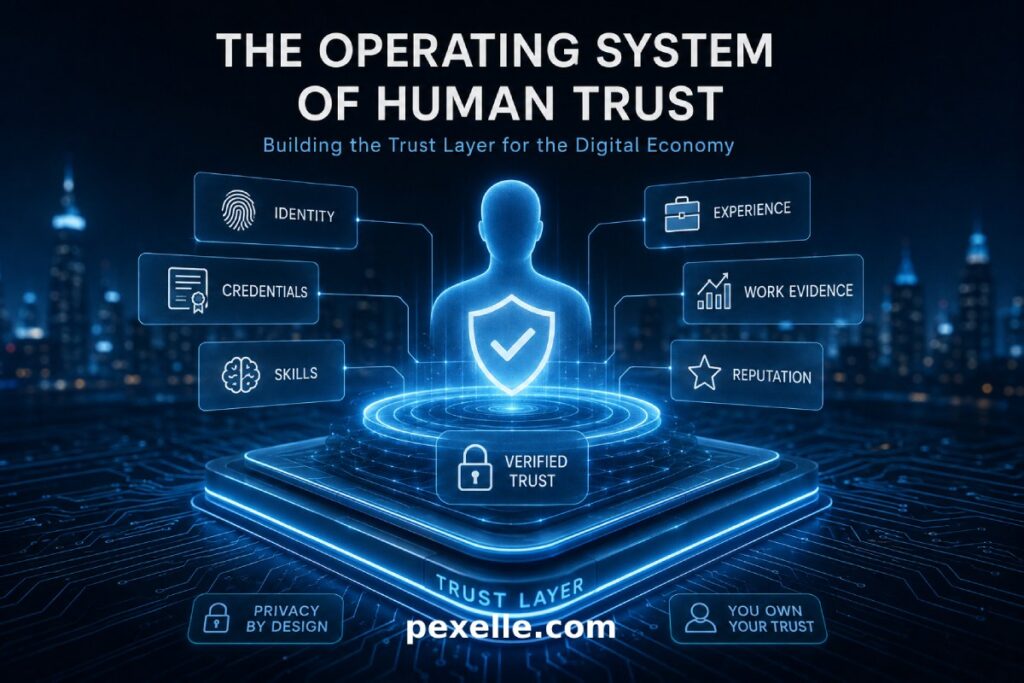
Human trust therefore requires multiple layers.
Identity
   ↓
Credentials
   ↓
Skills
   ↓
Experience
   ↓
Work Evidence
   ↓
Reputation
   ↓
Trust
The real opportunity is not simply creating better digital identities.
It is connecting these layers into a verifiable trust infrastructure.
3. From Profiles to Proof
The professional internet is largely built around profiles.
Profiles are containers of claims.
The next generation may increasingly revolve around proofs.
Instead of:
I am a senior software engineer.
a trust system could contain verifiable evidence associated with that claim.
For example:
Claim
Senior Backend Engineer

Evidence
47 verified production contributions

Organizations
3 verified employers

Projects
12 verified projects

Skills
Distributed Systems
Go
PostgreSQL
Kubernetes

Credential Issuers
University
Employers
Professional Organizations
Project Owners
The important change is not the amount of information.
It is the verification structure behind the information.
This direction is no longer purely theoretical. In May 2025, the World Wide Web Consortium published the Verifiable Credentials 2.0 family as W3C Recommendations. The standards provide mechanisms for representing credentials in forms designed to be cryptographically secure, privacy respecting, and machine-verifiable.
That creates an important building block.
But credentials alone are not the complete trust system.
The larger challenge is connecting credentials with real human activity.
4. Trust Should Become Portable
Today, reputation is usually trapped inside platforms.
- A seller builds reputation on one marketplace.
- A developer builds reputation on another platform.
- A driver accumulates ratings inside a transportation application.
- A freelancer completes hundreds of projects inside a freelance marketplace.
- A creator builds credibility on a social network.
Move to another platform and much of that accumulated trust disappears.
The individual may own the experience.
But the platform owns the representation of that experience.
A true human trust layer would change this relationship.
Trust could become portable.
Imagine completing a project for a company.
Instead of receiving only a review, the completion generates a cryptographically verifiable record.
Person
   ↓
Completed Project
   ↓
Verified by Organization
   ↓
Signed Evidence
   ↓
Added to Personal Trust Layer
The individual could later present that evidence elsewhere.
The next employer would not necessarily need access to the original platform.
It could verify the evidence independently.
This is a fundamental shift:
from platform-owned reputation to human-owned credibility.
5. Trust Should Be Composable
Trust is rarely created by one credential.
A university degree may matter.
- So may five years of professional work.
- So may a certification.
- So may successfully completing twenty projects.
- So may peer endorsements.
- So may a verified contribution to an open-source project.
Each piece represents only part of the picture.
A trust operating system would allow these pieces to become composable.
Identity Proof
      +
Education Proof
      +
Employment Proof
      +
Skill Proof
      +
Project Proof
      +
Reputation Signals
      =
Trust Context
Notice the final term is not simply a universal “trust score.”
That distinction matters.
Trust is contextual.
Someone can be highly trustworthy as a cybersecurity engineer while having no meaningful evidence that they can manage a construction project.
A person can be an excellent designer without being qualified to provide financial advice.
Therefore, a mature trust system should not ask:
How trustworthy is this human?
It should ask:
What evidence supports trusting this person for this specific action?
That produces a far more useful model of digital trust.
6. The Architecture of a Human Trust Operating System
If such infrastructure were built, it could contain several fundamental layers.
Layer 1: Identity
The system needs a reliable way to associate evidence with the correct person.
But privacy matters.
A person should not necessarily have to expose their entire legal identity every time they prove something about themselves.
Sometimes the relevant fact might simply be:
Over 18: TRUE
rather than revealing a full date of birth.
Or:
Licensed Professional: TRUE
rather than exposing an entire professional record.
The European Digital Identity Wallet provides a real-world example of this direction. The European Commission says EU Member States are expected to make digital identity wallets available by the end of 2026, allowing users to store and share identity information and digital documents while sharing only necessary information in relevant scenarios.
Layer 2: Credentials
Trusted institutions issue digitally verifiable claims.
Examples could include:
University → Degree
Government → License
Employer → Employment Record
Training Provider → Certification
Company → Project Completion
The recipient holds those credentials and can present them when necessary.
Layer 3: Evidence
Credentials prove formal facts.
Evidence proves activity.
This could include verified records of:
- projects
- contributions
- transactions
- completed contracts
- publications
- professional achievements
- evaluations
- responsibilities
- measurable outcomes
This is where the system begins moving beyond digital identity toward digital capability.
Layer 4: Reputation
Evidence accumulated over time can generate reputation.
But reputation should ideally be derived from transparent evidence rather than arbitrary popularity.
The difference is significant.
Followers ≠ Capability

Likes ≠ Reliability

Profile Views ≠ Competence

Verified Outcomes → Stronger Trust Signal
Layer 5: Verification
Any authorized system should be able to ask:
Is this credential authentic?

Was it issued by the claimed organization?

Does it belong to this holder?

Has it expired?

Has it been revoked?

Has the evidence been modified?
Verification must eventually become fast enough that machines can perform it automatically.
Layer 6: Permission
The individual should retain meaningful control over what is disclosed.
A trust system should not become a global surveillance database.
Instead of exposing everything, users should be able to present only the evidence necessary for a particular interaction.
That principle is critical because trust infrastructure without privacy infrastructure can easily become infrastructure for control.
7. APIs for Human Capability
One of the most important consequences of structured trust is that human capability could eventually become queryable by software.
Today an API might ask:
GET /weather/hamilton
Tomorrow an AI agent might need to ask something conceptually closer to:
Find:

Mechanical Engineer
Experience > 5 years
Verified CAD capability
Verified manufacturing projects
Available in New Zealand
Required credentials valid
Instead of searching millions of self-written profiles, the system could search verified capability data.
This could transform labor markets.
Hiring could move from:
Search
→ Read CV
→ Interview
→ Reference Check
→ Verify
→ Hire
toward:
Search Verified Capability
→ Request Relevant Proofs
→ Verify
→ Evaluate
→ Hire
Humans would still make important judgments.
But machines could handle much of the verification layer.
8. AI Makes This Infrastructure More Important
Artificial intelligence dramatically lowers the cost of generating convincing information.
AI can generate:
- résumés
- portfolios
- cover letters
- professional photographs
- websites
- certificates that visually resemble legitimate documents
- sophisticated written explanations
- realistic synthetic identities
- fabricated work samples
This creates an unusual economic effect.
As generating credible-looking information becomes cheaper, credible-looking information becomes less valuable as evidence.
The scarce resource becomes verification.
The question changes from:
Does this look professional?
to:
Can this be verified?
And eventually:
What cryptographic or institutional evidence exists behind this claim?
The more powerful generative AI becomes, the more valuable trustworthy provenance may become.
AI therefore does not eliminate the trust problem.
It amplifies it.
9. AI Agents Will Need Human Trust Infrastructure
There is another reason this becomes important.
AI systems themselves are becoming economic actors.
An AI agent may eventually be instructed:
Find an electrical engineer for this project.
The agent could discover thousands of candidates.
But discovery is only the first problem.
The agent must determine:
- whether the candidate exists
- whether their identity is valid
- whether their qualifications are authentic
- whether their experience is real
- whether required licenses remain valid
- whether previous work was actually completed
- whether the person satisfies the project’s requirements
An AI system cannot safely solve these questions by reading persuasive biographies.
It needs structured evidence.
The interaction could eventually resemble:
AI Agent
   ↓
Request Capability
   ↓
Trust Network
   ↓
Discover Humans
   ↓
Request Proof
   ↓
Verify Credentials
   ↓
Evaluate Evidence
   ↓
Recommend / Contract
The trust layer could therefore become an interface between human capability and machine intelligence.
10. Trust Could Become Infrastructure
The internet went through several major infrastructure transitions.
Information became searchable.
Communication became programmable.
Payments became digital.
Computing became cloud infrastructure.
Software became accessible through APIs.
Identity is increasingly becoming portable and digitally verifiable.
The next transition may involve credibility itself.
Not credibility as social popularity.
Not credibility as a five-star rating.
Not credibility as a polished profile.
But credibility as structured, portable, independently verifiable evidence.
The World Economic Forum describes digital trust through dimensions including security, reliability, accountability, privacy, transparency, interoperability, and related properties. It has also argued for making digital trust measurable rather than treating it purely as an abstract principle.
The important next step may be extending that thinking from trust in technology toward trust in digital human activity.
11. The Operating System Analogy
Why call this an operating system?
Because an operating system does not perform every application itself.
It provides shared infrastructure that applications use.
It manages:
Identity
Permissions
Resources
Communication
Security
Execution
A Human Trust OS could perform a similar role for digital economic relationships.
              APPLICATIONS

 Hiring     Freelancing     Banking
    │            │             │
 Education   Marketplaces   AI Agents
    │            │             │
    └────────────┬─────────────┘
                 │
        HUMAN TRUST LAYER
                 │
 ┌───────────────┼───────────────┐
 │               │               │
Identity      Credentials      Evidence
 │               │               │
Skills        Reputation      Permissions
 │               │               │
 └──────────── Verification ─────┘
Applications would not need to reinvent trust independently.
They could consume trusted evidence through common standards and protocols.
That is what would make trust infrastructure rather than merely another platform feature.
12. Trust Must Not Become a Single Number
There is also a dangerous version of this future.
Imagine every person receiving a universal numerical trust score.
Human Trust Score: 742 / 1000
Such a system might look efficient.
It could also be deeply problematic.
Human beings are multidimensional.
Context matters.
Evidence can become outdated.
Institutions can make mistakes.
Algorithms can encode bias.
Disputes occur.
Credentials can be revoked incorrectly.
People change.
A responsible trust architecture therefore needs principles such as:
Contextuality
Trust should relate to a specific capability or interaction.
Transparency
People should understand why a trust decision was produced.
Portability
Evidence should not remain permanently trapped inside one platform.
Privacy
Users should disclose only what is necessary.
Correction
Incorrect records need mechanisms for challenge and correction.
Interoperability
Credentials should work across organizations and systems.
Decentralized verification
No single company should necessarily become the unquestionable authority over every dimension of human credibility.
The goal should not be to create a machine that decides whether a human is “good.”
The goal should be to create infrastructure that helps others verify specific claims with reliable evidence.
13. From the Résumé Economy to the Proof Economy
For decades, professional opportunity has depended heavily on representation.
People write résumés.
Companies write job descriptions.
Candidates describe achievements.
Recruiters interpret profiles.
References provide opinions.
Platforms aggregate ratings.
But digital infrastructure is gradually making a different model possible.
A person could carry a persistent collection of verified professional evidence throughout their career.
Not simply:
I worked there.
but:
Verified.
Not simply:
I have this skill.
but:
Evidence available.
Not simply:
I completed this project.
but:
Completion cryptographically attested.
Not simply:
Trust me.
but:
Verify me.
This is the transition from a claim economy toward a proof economy.
14. Human Capital Could Become Machine-Readable
The implications go far beyond hiring.
If professional evidence becomes structured and permissioned, software could understand human capability at a much deeper level.
A company assembling a team could specify:
Need:

1 Structural Engineer
2 Backend Developers
1 UX Designer
1 Project Manager
An intelligent system could discover candidates based not merely on keywords but on verified experience.
It might reason about complementary skills.
It might verify mandatory credentials.
It might identify missing capabilities.
It might assemble temporary teams around projects.
The traditional organization chart could become more dynamic.
Talent could increasingly be discovered based on verified capability rather than institutional visibility.
Someone without a famous employer or elite university might still possess an extraordinary body of verifiable work.
That could create a more open professional economy.
15. The Emergence of a Trust Economy
Once trust becomes structured, portable, and verifiable, entirely new markets become possible.
Consider the infrastructure that could emerge around it:
Credential issuers
Organizations that issue trusted digital evidence.
Verification networks
Systems that validate proofs.
Trust wallets
Interfaces through which individuals manage credentials and permissions.
Reputation engines
Systems that interpret evidence within specific contexts.
Human capability protocols
Standards describing skills, achievements, and professional activity.
AI trust agents
Software that requests and verifies evidence before making decisions.
Trust marketplaces
Platforms where verified humans and organizations can transact with lower verification costs.
The result could be a new economic layer.
Not simply the creator economy.
Not simply the gig economy.
Not simply the AI economy.
A trust economy.
16. The Infrastructure Is Beginning to Appear
Pieces of this future already exist.
Verifiable Credentials have matured into W3C web standards.
Digital identity wallets are moving from experiments toward large-scale infrastructure. The European Commission says Member States are required to provide EU Digital Identity Wallets by the end of 2026, while ETSI announced its first standards supporting the wallet ecosystem in June 2026.
Cryptographic verification continues to improve.
Privacy-preserving proof systems are developing.
Digital signatures are already ubiquitous.
AI agents are becoming capable of performing increasingly complex workflows.
These developments currently appear as separate technological movements.
But they may eventually converge.
Digital Identity
       +
Verifiable Credentials
       +
Cryptographic Proofs
       +
Portable Reputation
       +
Human Work Evidence
       +
AI Agents
       =
Trust Infrastructure
That convergence could be far more important than any individual technology.
17. The Missing Protocol of the Digital Economy
The internet solved communication before it solved trust.
That was understandable.
Connecting computers was the first problem.
Connecting information came next.
Connecting commerce followed.
But as more of human life moves into digital systems, the unresolved question becomes increasingly visible:
How does one unknown human reliably trust another unknown human through software?
Platforms currently answer that question independently.
Banks build KYC systems.
Marketplaces build rating systems.
Employers build background-check systems.
Universities build credential databases.
Governments build identity systems.
Professional networks build reputation systems.
Every institution repeatedly reconstructs fragments of the same trust problem.
A shared trust layer could allow these systems to interoperate.
Not one database.
Not one company.
Not one universal score.
A protocol.
An ecosystem.
An infrastructure layer.
Conclusion: Trust Will Become Programmable
The first internet made information accessible.
The second wave made commerce digital.
Cloud computing made infrastructure programmable.
Artificial intelligence is making knowledge and execution increasingly programmable.
The next frontier may be trust itself.
Not trust as emotion.
Not trust as branding.
Not trust as popularity.
But trust as verifiable evidence exchanged between humans, organizations, and machines.
In that world, people may carry their professional credibility with them.
Skills could be backed by evidence.
Achievements could be independently verified.
Credentials could travel across platforms.
AI agents could evaluate trusted claims without requiring access to unnecessary private information.
Organizations could discover talent based on proven capability rather than self-description alone.
And digital relationships could increasingly begin not with:
but with:
“Verify me.”
The digital economy already has protocols for information, communication, identity, payments, and computation.
What it still lacks is a universal layer for human credibility.
Building that layer may become one of the defining infrastructure challenges of the next decade.
Because in an economy where information can be generated infinitely, proof becomes scarce.
And when proof becomes scarce, trust becomes infrastructure.
Source : Medium.com