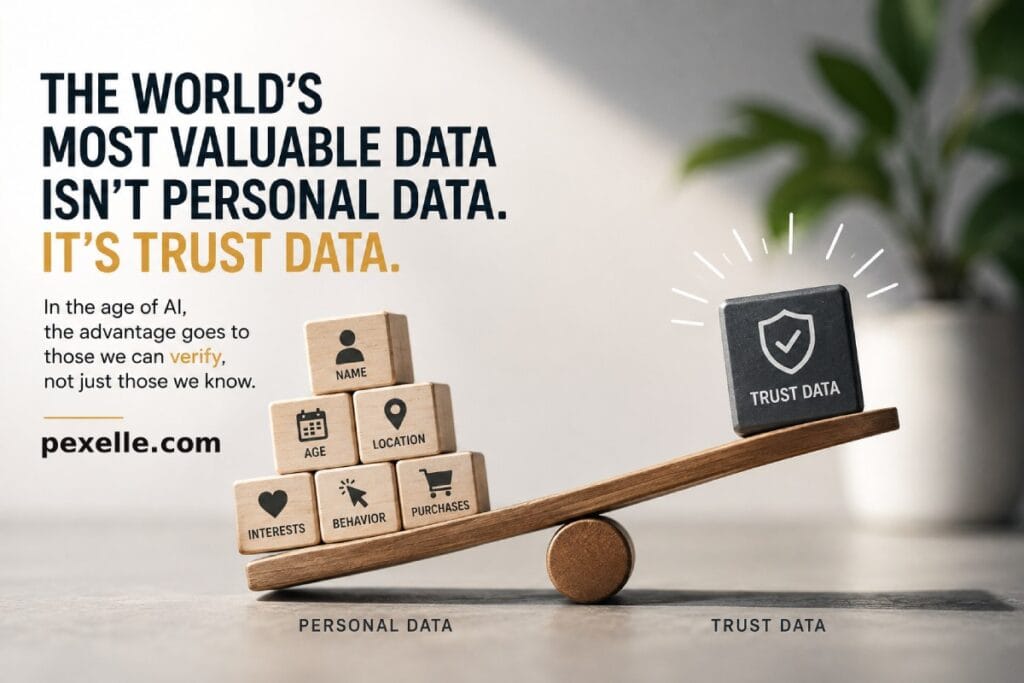
For more than two decades, the digital economy has been built around personal data.
- Who you are.
- Where you live.
- What you search for.
- What you buy.
- What you watch.
- Who you follow.
- What you click.
Technology companies learned how to collect these signals at enormous scale and turn them into advertising, recommendations, personalization, risk models, and competitive advantage.
Personal data became one of the defining resources of the internet economy.
But the next digital economy may be built around a very different category of information.
Not data about who you are.
Data about what can be trusted about you.
We can call it trust data.
And as artificial intelligence makes digital information dramatically easier to create, imitate, manipulate, and scale, trust data could become significantly more valuable than the personal data that powered the previous generation of technology.
From the Data Economy to the Trust Economy
The first generation of the internet was largely about information.
The second became increasingly about identity and behavior.
Platforms wanted to know who users were, what they liked, and what they were likely to do next.
That created the modern personal data economy.
But AI introduces a fundamental change.
Information itself is becoming abundant.
Documents can be generated instantly. Images can be synthesized. Professional profiles can be optimized automatically. Portfolios can be created quickly. Applications can be personalized at scale. Expert sounding answers can be produced by almost anyone.
The cost of producing something that looks credible is rapidly approaching zero.
This creates an unusual economic problem.
When credible looking information becomes abundant, actual credibility becomes scarce.
And scarce things become valuable.
The critical question of the AI economy therefore changes from:
“What do we know about this person?”
to:
“What can we reliably verify about this person?”
That difference may define the next generation of digital platforms.
What Is Trust Data?
Trust data is not simply another collection of personal information.
It represents evidence connected to claims.
Examples could include:
- whether a professional skill has been independently demonstrated
- whether someone actually contributed to a project
- whether a credential was issued by a legitimate institution
- whether a transaction or professional engagement occurred
- whether previous collaborators verified someone’s contribution
- whether a piece of work can be connected to its actual creator
- whether a professional claim has supporting evidence
- whether someone’s reputation has been established through repeated, verifiable actions
Traditional personal data describes the individual.
Trust data helps evaluate the reliability of claims associated with the individual.
That distinction is extremely important.
A profile might say:
“Senior AI Engineer with eight years of experience.”
That is identity information combined with a claim.
Trust data asks different questions.
Which projects demonstrate those eight years?
Which organizations can confirm the work?
What technical contributions can be attributed to the person?
Which skills were actually demonstrated?
What evidence supports those claims?
How recent is that evidence?
How independently was it verified?
The profile tells us what someone says.
The trust layer tells us what can be proven.
AI Is Creating a Verification Gap
Artificial intelligence is creating extraordinary productivity.
But it is simultaneously creating a new infrastructure problem.
The internet is gaining powerful tools for generating information much faster than it is gaining tools for verifying information.
Consider a hiring manager receiving 500 applications.
AI can help candidates create polished resumes, customized cover letters, optimized LinkedIn profiles, portfolio descriptions, project summaries, and technically sophisticated responses.
The result is not necessarily dishonesty.
The deeper problem is signal compression.
When everyone can produce highly polished professional signals, those signals become less useful for distinguishing genuine capability.
A beautifully written resume once contained some information about communication ability.
AI weakens that signal.
A polished portfolio once required considerable effort.
AI reduces that cost.
A detailed technical explanation once suggested significant knowledge.
AI can now generate one instantly.
This does not make these artifacts useless.
But it changes their evidentiary value.
The world therefore needs another layer.
A layer capable of answering:
Where did this claim come from, what evidence supports it, and how much confidence should we place in it?
That is the emerging role of trust data.
Personal Data Predicts Behavior. Trust Data Reduces Uncertainty.
The economic value of personal data has historically come from prediction.
If a platform understands your behavior, it can predict what advertisement you might click, what product you might purchase, what content you might watch, or whether you represent a particular financial risk.
Trust data has a different economic function.
It reduces uncertainty between people and organizations.
Imagine a company choosing between two software engineers.
Both have impressive resumes.
Both have strong portfolios.
Both perform well during interviews.
Traditional professional data may struggle to differentiate them.
Trust data could provide another dimension:
Candidate A has ten independently verified project contributions, multiple authenticated collaborators, validated technical achievements, and a history of successful work.
Candidate B has similar claims but little supporting evidence.
The decision becomes easier.
Trust data does not merely provide more information.
It increases the confidence attached to existing information.
And confidence has enormous economic value.
The Internet Has an Identity Layer, but Its Trust Layer Is Still Weak
The modern internet has become remarkably good at identifying people.
We have email addresses, phone verification, government identity systems, professional profiles, social accounts, digital signatures, biometric authentication, and increasingly sophisticated identity verification services.
These technologies can answer an important question:
“Are you really this person?”
But another question remains much harder:
“Are the things associated with this person actually true?”
Identity verification and claim verification are fundamentally different problems.
A platform may successfully confirm that someone is John Smith.
That does not automatically confirm that John Smith:
has five years of cybersecurity experience,
built the projects listed on his profile,
possesses the claimed technical skills,
contributed meaningfully to a particular company,
or produced the work shown in his portfolio.
The internet has invested heavily in proving identity.
The next major opportunity may be proving claims.
Trust Data Could Become Portable Infrastructure
Today, reputation is fragmented across platforms.
- Your professional history exists on one platform.
- Your code exists somewhere else.
- Your certifications exist across several institutions.
- Your freelance reputation belongs to another marketplace.
- Your transaction history exists inside another ecosystem.
- Your references live inside emails and private conversations.
Each platform owns a small fragment of your credibility.
This creates enormous inefficiency.
A more advanced digital economy could make trust portable.
Imagine a professional carrying a reusable trust layer containing verified evidence of skills, projects, credentials, collaborations, achievements, and professional history.
Instead of rebuilding credibility every time they enter a new platform, they could bring verified trust signals with them.
- A freelancer could move between marketplaces without losing years of reputation.
- A developer could prove contributions without exposing confidential source code.
- A designer could demonstrate verified project participation.
- A consultant could provide authenticated evidence of previous engagements.
- A student could accumulate verified evidence of capability long before receiving a traditional degree.
In such a system, trust would no longer belong entirely to platforms.
It could increasingly belong to individuals.
Trust Data Is More Than a Score
There is a dangerous temptation when discussing digital trust: reducing everything to a single number.
A universal “trust score” would create serious problems.
Trust is contextual.
Someone can be an excellent engineer and an inexperienced manager.
A highly trusted seller may have no meaningful credibility as a financial advisor.
A verified academic credential does not automatically validate every professional claim made by its owner.
The future of trust data should therefore not simply be:
Person X = 87/100 trustworthy.
A better model is evidence based and contextual.
For example:
Python Development
Strong evidence
12 verified projects
4 independent confirmations
Recent activity: 2026
Project Leadership
Moderate evidence
3 verified projects
2 organizational confirmations
Machine Learning Research
Limited evidence
1 verified contribution
No independent institutional verification
This creates something much more useful than a reputation score.
It creates a trust graph.
People, organizations, skills, projects, credentials, transactions, and evidence become connected through verifiable relationships.
The strength of a claim comes from the quality of those relationships.
Privacy Could Become a Competitive Advantage
There is another important difference between personal data and trust data.
Personal data systems often create value by collecting more information.
Trust systems may create value by revealing less.
Suppose an engineer needs to prove that they worked on a large financial platform.
A traditional verification process might require exposing the employer, project documentation, internal systems, or confidential details.
A better trust infrastructure could potentially verify the necessary claim without exposing all of the underlying information.
For example:
“Employment verified.”
“Project participation verified.”
“Contribution period verified.”
“Technical role verified.”
The verifier receives the confidence required for the decision without receiving unnecessary personal or confidential information.
This leads to an important principle:
The future of trust infrastructure should maximize verification while minimizing disclosure.
That could make trust data not only valuable, but fundamentally more privacy preserving than many existing data models.
Trust Will Become Machine Readable
Another major shift is coming.
Trust will increasingly be evaluated not only by humans, but by AI systems.
AI agents will hire services.
AI systems will recommend professionals.
Automated procurement platforms will evaluate suppliers.
Financial systems will evaluate counterparties.
Marketplaces will rank participants.
Recruitment systems will filter candidates.
Autonomous software agents may eventually negotiate with other agents on behalf of people and companies.
These systems will need something beyond profile descriptions.
They will need structured evidence.
Imagine an AI agent evaluating a cybersecurity consultant.
Instead of reading a biography and guessing credibility, it could inspect structured trust signals:
identity verified,
credential issuer authenticated,
seven relevant projects verified,
three enterprise clients confirmed,
recent professional activity validated,
no evidence supporting two additional profile claims.
The AI would not simply process information.
It would process the provenance and confidence of information.
This could make machine readable trust infrastructure one of the most important layers of the agentic economy.
The New Competitive Advantage: Verified History
The previous internet rewarded visibility.
Followers mattered.
Traffic mattered.
Engagement mattered.
Search ranking mattered.
Attention became currency.
But AI is making visibility easier to manufacture.
Content can be generated.
Engagement can be optimized.
Profiles can be automated.
Personal brands can be constructed faster than ever.
What remains difficult to manufacture is a long history of independently verifiable actions.
- You can generate a portfolio description in seconds.
- You cannot instantly generate five years of authenticated project contributions.
- You can generate an impressive professional biography.
- You cannot instantly generate a network of credible organizations confirming your work.
- You can generate claims.
- You cannot easily generate history.
That makes verified history increasingly valuable.
Companies Will Build Trust Graphs
The organizations that understand this shift may begin building something far more valuable than user databases.
They will build trust graphs.
Traditional databases answer questions such as:
Who is the user?
What did they purchase?
What pages did they visit?
What are their preferences?
Trust graphs could answer:
What has this person demonstrated?
Who verified it?
Which organization issued this credential?
Which project connects these professionals?
What evidence supports this claim?
How strong is the verification?
When was it verified?
Has contradictory evidence appeared?
This creates a new kind of digital asset.
Not simply information about users.
Structured relationships between claims, evidence, people, and institutions.
That infrastructure could become extremely difficult to replicate because its value increases over time.
A competitor can copy a user interface.
It can copy features.
It can even train similar AI models.
But recreating years of authenticated relationships and verified history is much harder.
Trust networks may therefore develop powerful network effects.
A New Category of Digital Capital
We usually think about capital as financial capital.
But the digital economy has created other forms.
Social capital.
Reputation capital.
Knowledge capital.
Audience capital.
Trust data could create another category:
verifiable capital.
A person’s accumulated evidence of competence, reliability, contribution, and achievement could become a portable economic asset.
This could have profound consequences.
Workers could carry professional credibility between employers.
Freelancers could own their reputation.
Students could accumulate evidence of capability outside traditional institutions.
Small companies could establish credibility faster.
Experts could distinguish themselves from AI generated imitation.
Organizations could evaluate partners with greater confidence.
The professional profile of the future may therefore look less like a resume and more like an evidence network.
The Next Data Race
The largest technology companies of the previous era competed to understand users.
Search companies understood intent.
Social networks understood relationships.
E-commerce platforms understood purchasing behavior.
Streaming platforms understood entertainment preferences.
Advertising networks connected all of these signals.
The next generation of platforms may compete around another question:
Who can build the most reliable infrastructure for understanding what is true?
Not truth in the philosophical sense.
Operational truth.
Did this happen?
Did this person do this work?
Was this credential actually issued?
Did these organizations collaborate?
Was this contribution real?
Does evidence support this professional claim?
These questions appear simple.
At global scale, they represent an enormous infrastructure challenge.
And potentially an enormous economic opportunity.
Trust Could Become the Scarce Resource of the AI Economy
Every technological revolution changes what becomes abundant and what becomes scarce.
The internet made information abundant.
Social media made publishing abundant.
Cloud computing made computing infrastructure widely accessible.
AI is making intelligence, content generation, and digital production increasingly abundant.
But abundance creates new scarcity.
- When information becomes infinite, trusted information becomes scarce.
- When content becomes infinite, provenance becomes valuable.
- When professional claims become easy to generate, verified capability becomes valuable.
- When synthetic identities become more sophisticated, authenticated relationships become valuable.
- When AI can imitate expertise, evidence of real expertise becomes valuable.
The defining resource of the AI economy may therefore not be more data.
It may be more trust.
Conclusion: The Most Valuable Dataset May Be the One That Proves Things
The personal data economy was built around understanding people.
The emerging trust economy may be built around verifying them.
That does not mean personal data disappears.
Behavioral data, identity information, and preferences will remain enormously important.
But another category of data is becoming strategically significant.
- Data that establishes provenance.
- Data that connects claims to evidence.
- Data that verifies relationships.
- Data that records demonstrated capability.
- Data that allows humans and machines to distinguish between what is merely stated and what is actually supported.
That is trust data.
And unlike traditional personal data, its greatest value may not come from knowing more about people.
Its value may come from allowing people to prove more while revealing less.
In an internet increasingly filled with generated content, generated identities, generated expertise, and generated claims, the most valuable digital asset may ultimately be the one thing that cannot simply be generated:
credible evidence of reality.
Source : Medium.com